learning GOALS
- Identify the factor of interest and response factor in an experiment.
- Identify the nuisance factors in an experiment.
- Identify the experimental and control groups in an experiment.
- Recognize random assignment.
- Identify which of two methods of replication was used in an experiment.
Experimental design refers to the structure of an experiment (a specific type of research method). How can the experiment be conducted efficiently, effectively, and responsibly, to return sound results? Researchers must carefully consider several key components of experimental design before any work is done to collect data.
In the upcoming activity, you will need to identify the key components of experimental design. We’ll take them one by one in the following questions.
Experimental Design
An experimental study, or experiment, is a specific method of research that is especially useful for determining cause and effect. Typically, a basic experiment design includes a treatment imposed by the researcher, a comparison between one group that receives the treatment and another group that does not, and random assignment of participants into each group. We’ll explore each of these concepts in more detail below.
To help you understand the key components of experimental design, consider this simplified experiment:
[insert an image of a lake? fish eggs? pH strips?]
An ecologist wants to know if acid rain affects the rate of reproduction for fish in a local lake. The ecologist incubates 1,000 fish eggs in healthy lake water (pH = 6.5) and another 1,000 fish eggs in acidic water (pH = 4.5). The eggs have been randomly assigned to either the healthy lake water group or the acidic water group. The water temperature, amount of dissolved oxygen, and amount and timing of light were kept at optimal levels for both groups. After 14 days, the ecologist counted how many eggs from each group had hatched.
Each of the questions below will ask about aspects of the design present in this experiment.
question 1
A good experiment always starts with a good research question. For an experiment, the research question is usually about whether one thing causes another. Fill in the blanks below to summarize the ecologist’s research question.
“Does ______________________ cause ________________________?”
Factors
In an experimental study, the factor of interest (also known as the explanatory variable or independent variable) is the factor that the researcher purposely changes or manipulates to see if it impacts a specific outcome. The treatments are the different levels of the factor of interest (or explanatory variable) you are changing (e.g., no vaccine vs. vaccine).
The response variable (also known as the dependent variable) is an objective measure of the research question that is measured at the end of an experiment and compared across the different levels of the factor of interest (or explanatory variable).
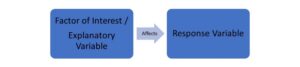
The nuisance factors are factors that are kept the same across all levels of the factor or are explicitly controlled in the experimental design. These factors are not of interest in the study but may affect a change in the response variable.
Video Placement
[A video briefly describing factor of interest, treatment, response variable, and nuisance factors. This should be no more than a minute long. ]
Example
Summarize the terminology surrounding factors by answering the questions below.
- The factor of interest is also known as the _________________. Fill in the blank.
- The response variable is also known as the ________________. Fill in the blank.
- What does the researcher purposely change or manipulate to see if it impacts a specific outcome? Choose all that apply
- a) experimental factor
- b) explanatory variable
- c) response factor
- d) factor of interest
- What are treatments in an experiment?
- a) medicine applied to one set of individuals but not the other
- b) the different levels of the factor of interest (or explanatory variable) you are changing
- What are nuisance factors in an experiment?
- a) types of observational units that are particularly bothersome such as loud talkers
- b) types of factors that researchers are unable to account for in an experiment
- c) factors that are kept the same across all levels of the factor or are explicitly controlled in the experimental design
- What is measured at the end of an experiment and compared across the different levels of the factor of interest?
Now you try. Use the definitions given above to answer Question 2. Remember to view the feedback for your answers to assess your understanding.
question 2
Identify the different parts of the experimental design in the previous simplified experiment.
Part A: What is the factor of interest?
- a) pH level
- b) Temperature
- c) Oxygen level
- d) Amount of light
- e) Timing of light
- f) Incubation duration
- g) Number of eggs hatched
Part B: What is the response variable?
- a) pH
- b) Temperature
- c) Oxygen level
- d) Amount of light
- e) Timing of light
- f) Incubation duration
- g) Number of eggs hatched
Part C: What are the nuisance factors in the previous experiment? There may be more than one correct answer.
- a) pH
- b) Temperature
- c) Oxygen level
- d) Amount of light
- e) Timing of light
- f) Incubation duration
- g) Number of eggs hatched