Controls
An important aspect of all experiments is a comparison between one or more groups or levels of the factor of interest, called treatments. In a simple experimental design, one group receives the researcher’s treatment and the other group(s) does not. The group that receives the treatment is commonly called the experimental group. The group that does not receive the treatment is usually called the control group. The control group is usually kept under conditions that are considered typical or common for a given situation.
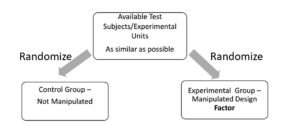
It is important to remember that the only difference between the experimental and control groups is the researcher’s manipulation of the factor of interest.
example
Complete the sentence by filling in the blank.
The _______________ is not manipulated, while the _________________ receives the researcher’s treatment.
Now you try answering Question 3 to identify the experimental and control groups in the simplified experiment given above.
question 3
In the previous simplified experiment:
Part A: Which group is the experimental group?
- a) 1,000 fish eggs in water with a pH of 6.5
- b) 1,000 fish eggs in water with a pH of 4.5
Part B: Which group is the control group?
- a) 1,000 fish eggs in water with a pH of 6.5
- b) 1,000 fish eggs in water with a pH of 4.5