Work in small groups to answer Questions 3 – 6.
question 3
A school psychologist wants to test the effectiveness of a new method for teaching reading. She recruits 80 first-grade students in District Code 75104 and randomly divides them into two groups. Group 1 is taught by means of the new method, while Group 2 is taught by the traditional method. The same teacher is assigned to teach both groups. At the end of the year, an achievement test is administered and the results are compared.
Part A: What is the factor of interest? What is the response variable?
Part B: What are some factors, other than the factor of interest, in the study that could affect test scores? How are they controlled?
Part C: What are the treatment groups?
Part D: What are the experimental units (or subjects)?
Part E: Are there any factors that cannot be controlled that might affect the test results? How can we minimize the effect that this variable may have on the outcome?
Part F: Previous research indicates that girls and boys may react differently to the two methods of instruction (there are an even number of girls and boys). How can you design an experiment that will control the effects due to gender on the scores on the achievement test (the response factor)? Complete the following template to illustrate your design.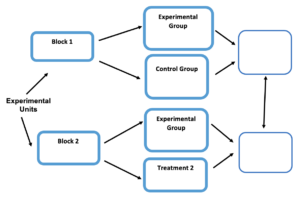
Guidance
[Sub-summary: How are you doing so far? Are you starting to develop a mental landscape for completely randomized block design? If so, try answering these questions in your notes:
- First, recall the key components of good experimental design.
Show Answer
- What are the basic principles of the completely randomized block design?
Show Answer
- What role does each principle play in the design?
Show Answer