Learning Goals
During this activity, you will:
- Identify misleading claims made using means
- Given characteristics of a distribution including skew and outliers, identify under which conditions it is appropriate to use the mean as a measure of center.
Click on a skill above to jump to its location in this activity.
Is It Worth It?
Consider this scenario. A college basketball player is skilled enough to make an NBA roster and is thinking about dropping out of college this year.

question 1
In this activity, you’ll use a distribution of professional basketball salaries to see how outliers influence different measures of center and how averages can be misleading.
recall
Before beginning this activity, take a moment to recall the meanings of the terms left-skewed, right-skewed, symmetric, and outlier. You’ll need to be able to use those terms to describe features of a data set.
Core skill:
video placement
[Intro: Starting from a sentence or two discussing Question 1, remind students that they have recently been working to calculate and interpret the mean and median of a data set. That is, the median is the value that splits the data in half, with half the observations above the mean and half below, regardless of the presence of skew or outliers. The median is fixed. But the mean is not; it gets pulled to the left or right of the mean under the presence of skew or outliers. The mean is sensitive to extreme values. So when we see that the mean is higher than the median, we say that it has been “pulled to the right,” and we understand the quantitative variable is skewed right. Likewise, if the mean is smaller, we’ll say it’s been “pulled to the left,” and we understand the quantitative variable is skewed left. If the mean and median are similar, though, we understand that the distribution is symmetric. In this activity, we’ll use a distribution of professional basketball salaries to explore how skew arises in a quantitative variable and why we must be careful to consider all the characteristics of a quantitative variable’s distribution before deciding if the mean or median would be more responsible to use as a measure of a “typical” value. ]
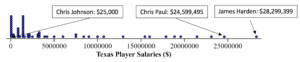
Below is a dotplot of NBA salaries[1] for Texas players in the 2017–2018 season:
question 2
question 3
- NBA player salary data set (2017-2018). (2018) Kaggle. Retrieved from https://www.kaggle.com/koki25ando/salary ↵