The Empirical Rule
recall
Before beginning the activity below, recall the definition of the Empirical Rule. What does it state?
Core skill:
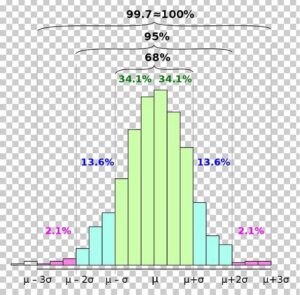
Consider the weights of the livers and spleens in [latex]26[/latex]-week old female C57BL/6J laboratory mice. The mean liver weight is [latex]0.999[/latex] grams (g) with a standard deviation of [latex]0.087[/latex] g, and the mean spleen weight is [latex]0.086[/latex] g with a standard deviation of [latex]0.007[/latex] g. Use this information along with the Empirical Rule to answer Questions 2 and 3 below. Round your answers to three decimal places.
question 2
question 3
video placement
[insert sub-summary video: “In these questions, you calculated specific values for the liver and spleen weights of the mice that marked locations in the data exactly one, two, and three standard deviations below the mean (to the left on the graph) and above the mean (to the right)). [this is voice over the graph of the Empirical rule again.] So, [pointing to the horizontal axis] what values are associated with 68% of the liver weights? That’s right, liver weights between 0.912 g and 1.086 g make up 68% of all the liver weights because these are all within one standard deviation of the mean. So, what do you think you’d consider an unusual liver weight, either unusually high or unusually low? In statistics, we oftentimes consider an observation unusual if it is at least two standard deviations away from the mean of a data set. What percentage of this data is within two standard deviations? That’s right, 95% percent. In this context, between which two values of spleen and liver weights are 95% of the data located? I’ll let you figure that one out for yourself and use it to answer the following question.”]