The Empirical Rule
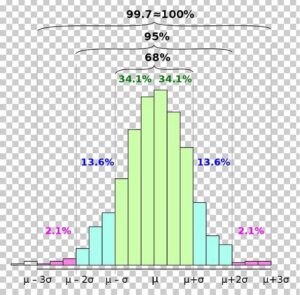
If a distribution is bell shaped, unimodal, and symmetric, then we can estimate how many observations are within a certain number of standard deviations. The Empirical Rule (also known as the [latex]68-95-99.7[/latex] rule) is a guideline that predicts the percentage of observations within a certain number of standard deviations.
the empirical rule
[insert a video describing (but not using) the Empirical Rule]–>this video could be good, but she refers back to other lessons and writes on the diagram in a way that could be confusing (calculating half of 68% and not others, uses x bar and s instead of mu and sigma, writes 99.7% on the outside of the bell while the others are clearly written inside). She begins an example at 4:41.
The Empirical Rule states that:
- about [latex]68[/latex]% of observations in a data set will be within one standard deviation of the mean.
- about [latex]95[/latex]% of the observations in a data set will be within two standard deviations of the mean.
- about [latex]99.7[/latex]% of the observations in a data set will be within three standard deviations of the mean.
Graphically, the Empirical Rule can be expressed like this:
Fill in the blank for each of Questions 10 – 12