learning GOALS
At the end of this page, you should feel comfortable performing these skills:
- Identify the population for a given study.
- Identify the parameter of interest for a given study.
- Determine whether a sampling method is biased and explain why.
In the upcoming activity, you will need to identify a population and a parameter of interest. You will also need to determine if a sampling method is biased or unbiased.
Each day, we encounter news headlines such as “Nearly Half of U.S. Parents Want More Noncollege Paths”[1] or statements like “Roughly seven-in-ten Americans say they ever use any kind of social media site.”[2] Where are these statistics coming from? Researchers could not have taken a census of all U.S. parents or all Americans to arrive at these conclusions. Instead, these statistics came from a sample of individuals from these groups.
Sampling
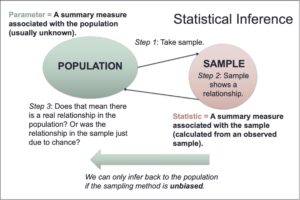
One primary use of statistics is to make inferences about a population based on data collected on a sample from that population. The population is the group of individuals or entities that our research question pertains to (e.g., all Americans), and a parameter is a numerical summary measure that summarizes that population (e.g., the proportion who use social media). A sample is a group of individuals or entities on which we collect data, and a statistic is a numerical summary measure of a sample.
This process of statistical inference is shown in the following figure.
Video Placement
[Perspective: a 3-instructor video that shows how to think about the above terms broadly related (i.e., not in detail — we’ll see methods listed in 2B — but just whether or not the method produces a representative sample). This shouldn’t be an entire lecture but just a sentence or two to help students associate parameter with population and sample with statistic and explains what it means that a sampling method is unbiased, (and if unbiased, then representative which permits us to generalize / make inferences.)
Later in this course, we will explore the idea of statistical inference in more detail. For now, we will focus on determining if our sample is representative of the population. A sampling method is unbiased if, on average, it results in a representative sample of the population. A sampling method is biased if it has a tendency to produce samples that are not representative of the population. If the sampling method is biased, we cannot generalize our results to the population and can only make statements about the sample itself.
Sampling from Populations
Let’s try to identify the population and parameter in a description of a study. We’ll also determine whether the sampling method in the study was biased or unbiased. See the video below for a demonstration, then try Questions 1 and 2.
Video Placement
[Worked Example: a 3-instructor worked example in the style of Questions 1 and 2.]
Example
[Optional — This could be a good location to briefly introduce a choose-your-own study example in the style of Questions 1 and 2 — these tasks are challenging for students. An active example would be beneficial in addition to the 3-instructor worked example.]
question 1
1) A television station is interested in predicting whether or not a local referendum to legalize marijuana for adult use will pass. It asks its viewers to phone in and indicate whether they are in favor of or opposed to the referendum. Of the 2,241 viewers who phoned in, 45% were opposed to legalizing marijuana.
Part A: What is the population?
- a) The 2,241 viewers who phoned in
- b) All local voters
- c) Whether the viewer is in favor of or opposed to the referendum
- d) All viewers of the television station
Part B: What is the parameter of interest?
- a) Whether the viewer is in favor of or opposed to the referendum
- b) The value 45% measured on the sample
- c) The proportion of all local voters who opposed legalizing marijuana
- d) The number of viewers who opposed legalizing marijuana
Part C: Is the sampling method biased or unbiased? Explain.
question 2
2) Gallup has been tracking presidential job approval in the United States for over 80 years.[3] In their presidential approval survey, Gallup asks “Do you approve or disapprove of the way [president’s name] is handling his job as president?” Recently, a random sample of 1,395 U.S. adults was selected by random-digit dialing of both landlines and cell phones, but only 256 of those selected chose to respond to the survey. Of those who responded, 48% said they approved of the way the president is handling his job.
Part A: What is the population?
- a) The president of the United States
- b) The 1,395 U.S. adults selected for the survey
- c) The 256 U.S. adults who responded to the survey
- d) All U.S. adults
Part B: What is the parameter of interest?
- a) The proportion of U.S. adults who responded to the survey
- b) The proportion of U.S. adults who approved of the way the president is handling his job
- c) Whether a U.S. adult approves of the way the president is handling his job
- d) The proportion of those who responded to the survey that approve of the way the president is handling his job
Part C: Is the sampling method biased or unbiased? Select all that apply.
- a) Unbiased, since a random sample was selected
- b) Biased, since the sample size is too small
- c) Biased, since those who chose to respond may be systematically different than those who chose not to respond
- d) Unbiased, since random-digit dialing was used
- e) Biased, since not all U.S. adults may have a phone
- 1 Hrynowski, Z. (2021, April 7). Nearly half of U.S. parents want more noncollege paths. Gallup.https://news.gallup.com/poll/344201/nearly-half-parents-noncollege-paths.aspx ↵
- Auxier, B. & Anderson, M. (2021, April 7). Social media use in 2021. Pew Research Center. https://www.pewresearch.org/internet/2021/04/07/social-media-use-in-2021/ ↵
- Newport, F. (2001, July 25). Examining presidential job approval. Gallup. https://news.gallup.com/poll/4723/examining-presidential-job-approval.aspx ↵