Learning Goals
This activity provides an opportunity to refresh the following skills:
- Round decimals to a specified place value
- Convert decimals and fractions to percents
- Convert fractions or mixed numbers to decimals
- Find the unknown in a percent problem
You will also become familiar with these skills:
Throughout much of this course you will need to read and interpret frequency tables, bar graphs, and pie charts. These kinds of tables, graphs, and charts help us to visualize data collected about a situation in order to understand it clearly. To help you gain familiarity and practice with these ideas before the course section begins, let’s work with a small data set to see what methods are available to us for visualizing the data. You’ll also need an understanding of percentages and relative frequencies. Look for the recall boxes in the text and/or refer to the Student Resource pages indicated there if you need a refresher.
Shark Attacks
In this corequisite support activity, we’ll look at shark attacks in the United States and internationally. We will see how visual displays like tables and graphs can help us analyze the number of shark attacks that occur in each country or U. S. state.

Carcharodon carcharias
To frame the landscape for this activity, think about shark attacks for a moment. What areas of the country or the world seem to be associated with a lot of interaction between sharks and humans? The United States and Australia might come to mind. Consider the two questions below.
In the United States, which state do you think has the most shark attacks?
Which country in the world do you think has the most?
We can use data to answer questions like this. We’ll need to organize and visualize the data first to make it useful for drawing conclusions. A tool that is commonly used to organize data like the number of shark attacks per location is a frequency table.
Frequency tables
Frequency tables include information about a number of times something occurs, also known as the frequency of occurrences. One column in the table lists different categories or groups. Another column lists the frequency of occurrences associated with each category or group.
Interactive Example
Suppose your school has decided to get a large number of people together for an evening to watch the popular TV show, Shark Week. The refreshment committee sent out a survey asking everyone to list a preference for one of 5 snack options and received 73 responses. The table below lists all the snacks on the survey and the number of people who listed each as their preference.
| Refreshment Options for Shark Week Watch Party | |
| Snack | Count |
| Pizza | 22 |
| Sliders | 13 |
| Chip and Dip | 12 |
| Wings | 19 |
| Veggie Tray and Dip | 7 |
- How many people said they would prefer chip and dip as the refreshment at the party?
- What were the least two favorite snacks of all the responses?
Now you try it with the shark attack data listed below.
Below is a frequency table of shark attacks in the United States.[1] A frequency table organizes categorical data by listing the different possible categories and the number of times each category occurs in the dataset. For example, in the table below, we see that over some period of time California had [latex]33[/latex] shark attacks, Florida had [latex]203[/latex], and so on.
| Shark Attacks in the United States |
|
| U.S. State | Count |
| California | [latex]33[/latex] |
| Florida | [latex]203[/latex] |
| Hawaii | [latex]51[/latex] |
| North Carolina | [latex]23[/latex] |
| Other | [latex]27[/latex] |
| South Carolina | [latex]34[/latex] |
| Texas | [latex]16[/latex] |
question 1
question 2
question 3
Relative frequency
When considering data in a frequency table, we often want to know how much a certain frequency represents of the total. For example, 23 shark attacks in North Carolina sounds like quite a lot. But how much of all shark attacks do those 23 represent? Knowing the answer to that may help us feel better about deciding on a location for a beach vacation. Listing the relative frequency for each of the counts in a table will help to understand this.
The relative frequency is a proportion (or percentage) of a particular category out of the entire group. See the interactive example below for a demonstration of how to calculate the relative frequency of shark attacks in North Carolina. You may wish to refresh your skills to convert fractions to proportions or percentages in the Recall box first.
recall
To write the relative frequency of an item in a frequency table, divide the frequency (count) of an item by the total frequency of the table.
Ex. Calculate the relative frequency of shark attacks in North Carolina as a proportion rounded to [latex]4[/latex] decimal places.
Core Skill:
Core Skill:
[Also see Corequisite Support Activities 1E and 2D for more practice.]
Interactive example
For example, in the table Shark Attacks in the United States, we can see that the [latex]23[/latex] shark attacks in North Carolina were out of [latex]387[/latex] shark attacks in all the states combined. If we want to know what proportion or percentage of the total attacks occurred in North Carolina, we can express them as a ratio (fraction), then convert the ratio to a proportion (decimal) or a percentage.
[latex]\dfrac{\text{# attacks in N.C.}}{\text{# total attacks}}=\dfrac{23}{387} \approx0.0594[/latex] or about [latex]5.94[/latex]%
We can express the relative frequency by saying either of the following.
The proportion of U.S. shark attacks in North Carolina is [latex]0.0594[/latex]
About [latex]5.94[/latex]% of U.S. shark attacks occurred in North Carolina.
Compute the relative frequencies for each of the following location. Recall that there were [latex]387[/latex] total attacks.
- California: [latex]33[/latex] attacks
- Florida: [latex]203[/latex] attacks
- Hawaii: [latex]51[/latex] attacks
Frequency tables commonly include a column for relative frequency, expressed as a proportion (decimal) or a percent. See the Recall box above for a refresher on how to convert fractions to proportions and percentages then complete the missing information in the table below.
Recall that a relative frequency represents the proportion or percentage of a particular frequency out of the total frequency. The table below contains the same information as the one you examined above, but adds columns for Proportion and Percent (%). For example, we can see in the table that the proportion of shark attacks that occurred in California out of the total number of shark attacks is [latex]0.0853[/latex], which is equivalent to [latex]8.53[/latex]% of all the shark attacks listed. In the following question, you’ll need to compute the missing proportion and percent for the rows Other, South Carolina, and Texas.
| Shark Attacks in the United States |
|||
| U.S. State | Count | Proportion | Percent (%) |
| California | [latex]33[/latex] | [latex]0.0853[/latex] | [latex]8.53[/latex] |
| Florida | [latex]203[/latex] | [latex]0.5245[/latex] | [latex]52.45[/latex] |
| Hawaii | [latex]51[/latex] | [latex]0.1318[/latex] | [latex]13.18[/latex] |
| North Carolina | [latex]23[/latex] | [latex]0.0594[/latex] | [latex]5.94[/latex] |
| Other | [latex]27[/latex] | ||
| South Carolina | [latex]34[/latex] | ||
| Texas | [latex]16[/latex] | ||
question 4
Bar graphs
Bar graphs are visual displays of data in which the frequency of each category listed across the horizontal axis is indicated by the height of its corresponding rectangular bar (or the length if the graph is displayed horizontally). Bar graphs can be displayed vertically, as the ones you’ll see here, or horizontally. See the interactive example below for a demonstration of how to read a bar graph.
Interactive example
The graph you see here is a portion of a larger graph that you’ll see following this demonstration. The full graph will display data about internationally occurring shark attacks. This portion shows just the attacks in the United States. The states are listed, one by one across the horizontal axis. Each bar rises to a number along the vertical axis representing the number of shark attacks recorded in that state.
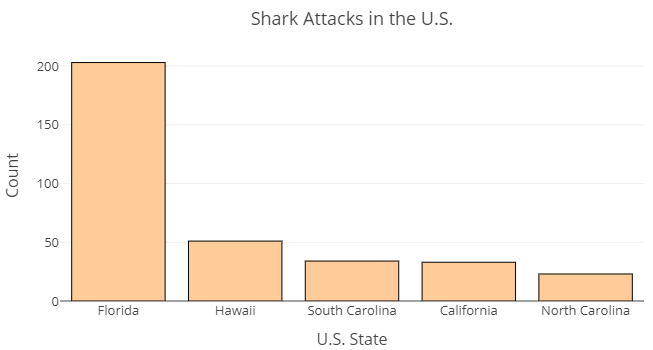
Use this chart (rather than the frequency table you saw earlier) to answer the following questions.
- According to the bar graph, about how many shark attacks occurred in Florida?
- What two states appear to have recorded about the same number of attacks?
- About how many attacks does the bar graph indicate occurred in Hawaii?
- About how many attacks occurred in North Carolina?
Now it’s your turn to try reading a bar graph. The image below is a bar graph (also known as a bar chart) of [latex]689[/latex] shark attacks across the globe.[2] Note that each country or state is listed along the horizontal axis. The height of each bar provides a visual representation of the number (count) of shark attacks that occurred in each country. We cannot read the exact frequency of each bar from a bar graph. Rather, the display helps us to visualize the frequencies relative to one another.
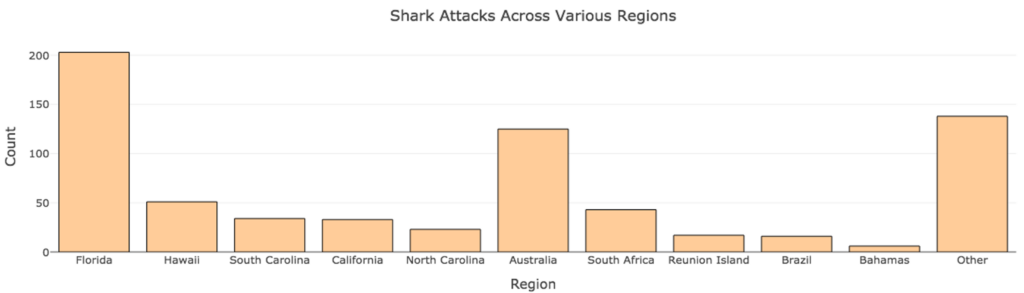
Use the chart to answer the questions below.
question 5
question 6
question 7
Pie Charts
Pie charts display data in a round graph, split into “pie pieces,” each representing a relative frequency. A key is provided to identify the categories associated with each relative frequency. Pie charts are useful for visually comparing relative frequencies.
Interactive example
Let’s say we were interested in comparing the percentage of shark attacks occurring in the United States and Australia versus the rest of the globe. We could create pie chart like the one below. This chart takes [latex]689[/latex] international shark attacks and divides them into three categories: attacks occurring in the United States, in Australia, and all other locations.
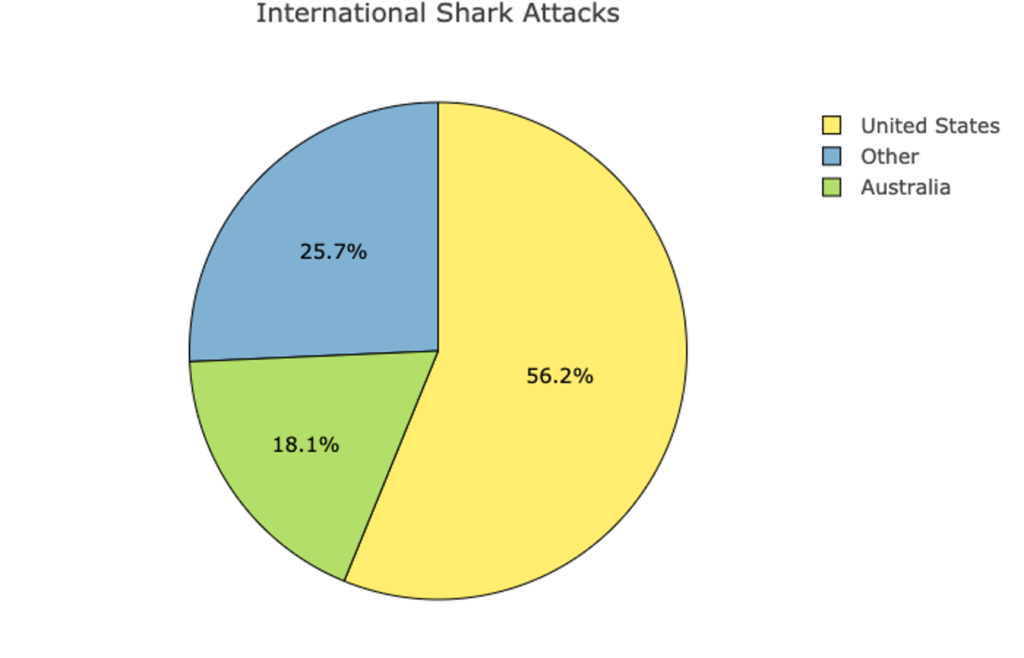
Use this pie chart to answer the following questions.
- What percent of attacks happened in Australia?
- Approximately how many of the total 689 attacks happened in Australia?
If needed, see the recall box below to refresh how to determine what number a certain percent represents in a given total.
recall
When working with percentages, it is often helpful to convert them to counts.
Core skill:
Now it’s your turn. Here is the pie chart from the interactive example above showing the relative frequencies of all [latex]689[/latex] international shark attacks that occurred in the U.S., Australia, and all other locations.
Use the pie chart above to answer the following two questions.
question 8
question 9
Let’s try one more. The following is a pie chart of [latex]387[/latex] shark attacks in the United States. Use the information from the table to determine how many shark attacks in each of the two categories shown.
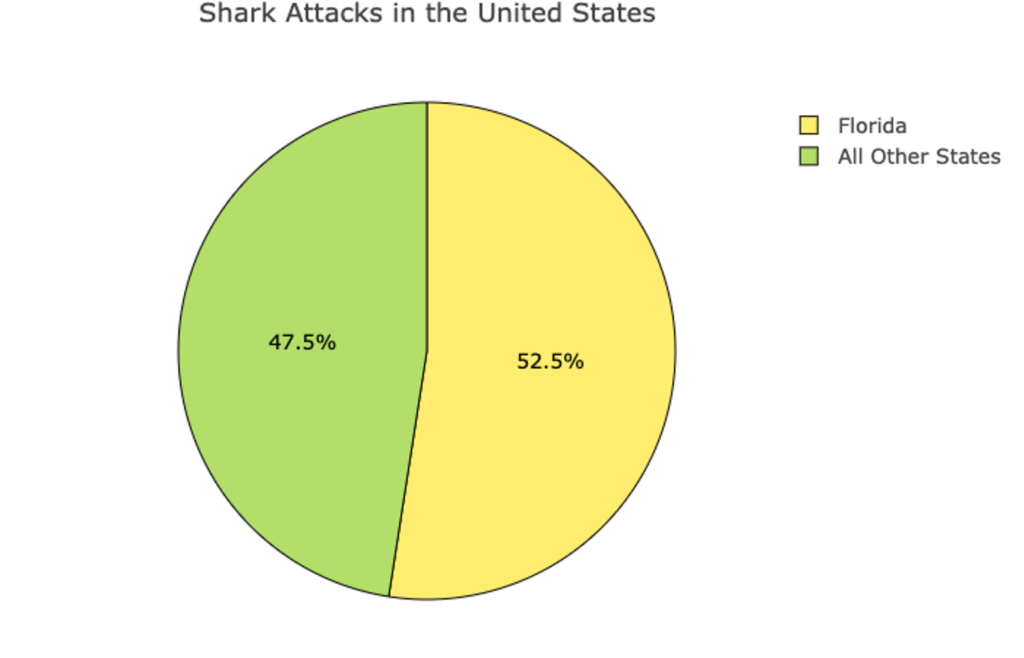
question 10
question 11
You’ve seen how to read information presented in frequency tables, bar charts, and pie charts and you’ve learned to calculate relative frequencies. You’ve also seen how to interpret the information displayed, and that sometimes it is helpful to convert numbers between ratios, proportions, and percentages in doing so. If you feel comfortable with these skills, then it’s time to move on to the next section.
Candela Citations
- Introductory Statistics: Analyzing Data with Purpose, First Edition 2021. Provided by: The Charles A. Dana Center at The University of Texas at Austin. Located at: https://www.utdanacenter.org/our-work/higher-education/curricular-resources-higher-education/introductory-statistics-analyzing-data-purpose-isap. License: CC BY-NC: Attribution-NonCommercial
- Sharks US only (csv). (n.d.). The Art & Science of Learning from Data. Retrieved from https://img1.wsimg.com/blobby/go/bbca5dba-4947-4587-b40a-db346c01b1b3/downloads/sharksUS.csv?ver=1622756678385 ↵
- Sharks (csv). (n.d.). The Art & Science of Learning from Data. Retrieved from https://img1.wsimg.com/blobby/go/bbca5dba-4947-4587-b40a-db346c01b1b3/downloads/sharks.csv?ver=1622756678385 ↵