9B/9C

Sample Sample Proportion
1
2
3
4
5
Skill or Concept: I can . . . Questions to check your understanding Rating
from 1 to 5
Identify whether a summary measure is a parameter or a statistic. 1
Determine the appropriate type of plot for a given dataset. 3, Part A
Simulate sample proportions of random samples of a given size from a population with known . 4, 5
Describe and interpret features of a sampling distribution of sample proportions. 2

3, Part B

3, Part C

4–6

Calculate the standard deviation of a sample proportion. 7

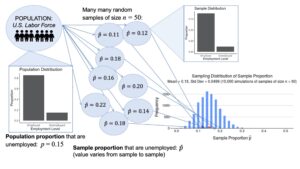
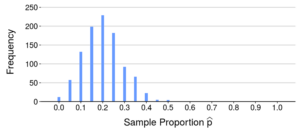
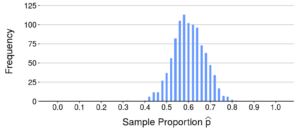
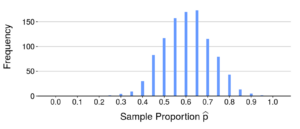
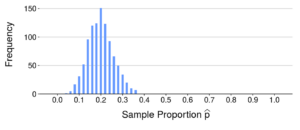
A display showing a graph labeled "Unemployment."A disAn illustration of various terms related to sampling and distribution. In the top left corner, there is a bubble labeled “Population: U.S. Labor Force.” Beneath this bubble is a bar chart titled “Population Distribution.” The bar chart is labeled “Employment Level” on the x-axis and “Proportion” on the y-axis. For “Employed,” the count is approximately 0.85. For “Unemployed,” the count is approximately 0.15. Beneath this graph is a caption reading “Population proportion that are unemployed: p = 0.15.” From the bubble labeled “Population: U.S. Labor Force,” there are also several arrows pointing to other bubbles. Above them, there is text reading “Many many random samples of size n = 50.” The bubbles are labeled the following: “p = 0.11,” “p = 0.12,” “p = 0.18,” “p = 0.16,” “p = 0.20,” “p = 0.22,” “p = 0.14,” and “p = 0.18.” From the bubble labeled “p = 0.12,” there is a bar chart to the right titled “Sample Distribution.” On the x-axis, it is labeled “Employment Level,” and on the y-axis, it is labeled “Proportion.” For “Employed,” the proportion is approximately 0.88, while for “Unemployed,” the proportion is approximately 0.12. Each of the bubbles also has an arrow leading from it to a graph in the bottom righthand corner. This graph is titled “Sampling Distribution of Sample Proportion,” with a subheading that reads “Mean = 0.15, Standard deviation = 0.0499 (10,000 simulations of samples of size n = 50).” On the x-axis, the graph is labeled “Sample proportion p, and on the y-axis, the graph is labeled “Frequency.” The graph is a bar graph with a peak around approximately 0.14. There is a dot at approximately 0.15. Beneath this graph and the bubbles to its left, there is text that reads “Sample proportion that are unemployed: p (value varies from sample to sample).” Someone's feet standing on a scale with a measuring tape in front of them. A graph of sample proportion p on the x axis against frequency on the y-axis. There is a peak at 0.2 on the x-axis with a frequency of approximately 225. The spaces between bars is approximately 0.05. A graph of sample proportion p on the x axis against frequency on the y-axis. There is a peak at approximately 0.6 on the x-axis with a frequency of approximately 112. The spaces between bars is approximately 0.02.A graph of sample proportion p on the x axis against frequency on the y-axis. There is a peak at approximately 0.6 on the x-axis with a frequency of approximately 175. The spaces between bars is approximately 0.05. A graph of sample proportion p on the x axis against frequency on the y-axis. There is a peak at 0.2 on the x-axis with a frequency of approximately 150. The spaces between bars is approximately 0.02.

Skill or Concept: I can . . . Questions to check your understanding Rating
from 1 to 5
Describe how the center, spread, and shape of a sampling distribution of a sample proportion varies with the sample size, , and the population proportion, . 1–4
Use a normal distribution to approximate probabilities involving a sample proportion. 5, Parts A and B
Use a normal distribution to approximate percentiles of a sample proportion. 5, Part C
sampling distribution
the distribution showing how sample proportions vary from sample to sample.
population distribution
the distribution showing how individuals vary in a population.

Glossary 9C

percentile
the value at which a certain percentage falls below that value.
Central Limit Theorem
as the sample size gets larger, the distribution of the sample proportion will become closer to a normal distribution.