objectives for this activity
During this activity, you will:
- Use a data analysis tool to describe variability of data.
- Find and interpret the standard deviation of data.
Click on a skill above to jump to its location in this activity.
It’s Showtime!
Have you ever thought about how long or how short some movies are? You might have the idea that a typical movie runs a little under two hours but movie runtimes cover a broad range. The shortest feature films have run just over an hour, while the longest run three and even four hours. Have you ever thought about why there is such variability in the length of movies?

In this activity we’ll explore movie lengths or “runtimes” and the ratings that go along with the runtimes. Let’s compare the movie runtimes for rated G (General Audiences, All Ages Admitted) and rated R (Restricted, Children Under 17 Require Accompanying Parent or Adult Guardian) movies.[1] Along the way, you’ll gain an understanding of how variability is reflected in graphical displays and described using numerical summaries.
Before beginning, consider the following question.
question 1
video placement
[Guidance: Think about your answer to Question 1. What kind of movies do you prefer watching? How long do they tend to be? Do you tend to watch a particular movie rating more often than the others? This activity explores the variability in movie runtimes across different ratings. The activity is a quick one, and relies heavily on the data analysis tool. You’ll need an understanding of the three variability measures: standard deviation (which you calculate using technology), variance (which you’ll need to calculate by hand; it’s the square of the standard deviation), and range (which you’ll calculate by hand using the minimum and maximum values given in the tool)].
Variability
Let’s use a dataset of movie runtimes to explore variability using technology. Follow the directions below to display the descriptive statistics for the database: Movie Run Time, and use the results to answer Questions 2 – 4 below.
Go to the Describing and Exploring Quantitative Variables tool at https://dcmathpathways.shinyapps.io/EDA_quantitative/.
Step 1) Select the Several Groups tab.
Step 2) Locate the drop-down menu under Enter Data and select From Textbook.
Step 3) Locate the drop-down menu under Dataset and select Movie Run Time.
question 2
question 3
question 4
Standard Deviation
Let’s explore the impact of the outlier on the variability of the G-rated movies. In the G-rated group, select and remove the outlier of [latex]357[/latex]. As illustrated in the following screenshot, highlight the value [latex]357[/latex] and delete.
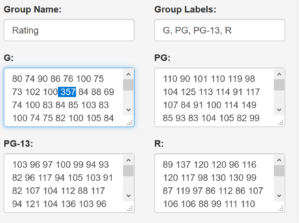
Explore the impact of removing the outlier by answering Questions 5 – 7 below. What do you notice about the varia
 question 5
question 6
question 7
video placement
[wrap-up: The goal of this activity is to understand that standard deviation is sensitive to outliers and is not a perfect measure of variability. “What did you think about how sensitive std dev is to the presence of outliers? How did the dot in the G-rated distribution affect the numerical summary? Let’s examine the range of the G-rated distribution. Note that the max value is 357, but the data is clearly concentrated between about 70 and120. Let’s look again at what happens to the mean of the distribution when we remove the outlier. The median stays about the same, which makes sense since it’s the middle data value. But the mean drops from a position well to the right of the median back to even with the median. And the variance drops from about 625 to about 121 — pretty significant! The key take-away is that our ideas of center and spread are affected greatly by the presence of outliers, and they should be used responsibly. Standard Deviation can give us an idea of variability, along with other characteristic about a distribution, but it is not a perfect measure. ]
- What do movie ratings mean? (n.d.). Showbiz.Junkies. Retrieved from https://www.showbizjunkies.com/mpaa-ratings/ ↵