What you’ll need to know
In this support activity you’ll become familiar with the following:
- Compare a single variable across groups using dotplots.
- Compare a single variable across groups using histograms.
You will also have an opportunity to refresh the following skills:
In the next section of the course material you will refresh your knowledge of mean and median by calculating them for a small dataset. In the following activity, you’ll use technology to calculate them for larger datasets in order to read, interpret, and make comparisons of centers between histograms. In this support activity, you’ll review reading and interpreting graphs that display the distribution of quantitative data, dotplots and histograms.
Graphical Displays Illustrating Frequency
Let’s begin by re-visiting data from a sleep study [1] of college students that we saw in Forming Connections in Displaying Categorical Data: 3A. We’ll explore and compare the distributions of a few of the numerical variables from the study, including alcoholic drinks consumed per week, hours of sleep per night on the weekends, and classes missed in a semester.
Read and interpret a dotplot
Below we are given a dotplot for the variable Alcoholic Drinks Per Week. Recall that a dotplot is used to display the frequency and distribution of a quantitative variable. Use this dotplot to answer Questions 1-3.
Recall
You may wish to refresh your understanding of how data is represented in a dotplot.
Core skill:
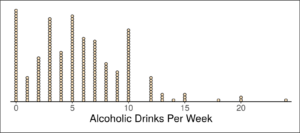
In order to use a graphical display to answer questions about the dataset, it helps to first ask yourself a question or two to become familiar with the visualization. We’d like to know what information this dotplot conveys about the participating students in the study. Then we can use it to answer questions about the data. Question 1 will help orient you to the information presented in the dotplot. Questions 2 and 3 ask specifically about the data.
question 1
What is the variable of interest represented in the dotplot? Is it categorical or quantitative? What does each dot in the dotplot represent? Discuss the most and least frequent responses. Are there any unusual observations?
Now that you are familiar with the information presented in the display, you can use it to answer questions about the data.
question 2
How many students in this study stated that they consume 9 alcoholic drinks per week?
question 3
According to the dotplot, which group is larger: the number of students who consume 5 alcoholic drinks per week or the number of students who consume 10 alcoholic drinks per week? How do you know?
Next, we’ll see how a histogram presents information about the distribution of a quantitative variable.
Read and interpret a histogram
Below we are given a histogram for the variable Hours of Sleep Per Night (Weekend). Recall that a histogram displays the distribution of a quantitative variable but, unlike the dotplot in which each observation is stacked above each value appearing, a histogram gathers groups of observations up into its bars.
recall
You may wish to refresh your understanding of how data is represented in a histogram.
Core skill:
Use the following histogram to address Questions 4-7.
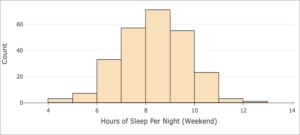
As you did with for the dotplot above, first orient yourself to the information conveyed in the histogram by answering Question 4. Then, compare and contrast the histogram to the dotplot in Question 5. Finally, read and interpret the histogram to answer Questions 6 and 7.
question 4
What is the variable of interest displayed in the histogram? Is it categorical or quantitative? What does the height of each bar in the histogram represent? What appears to be the tendency of responses for the variable of interest?
Now that you are familiar with the information presented in the histogram, look back at the dotplot and consider general differences and similarities in the two types of displays.
question 5
Compare and contrast a histogram and dotplot. In what ways are they similar? In what ways are they different?
Histograms are more commonly encountered than dotplots as a visualization of quantitative data since they can more concisely display large datasets. Dotplots are more appropriate for smaller sets of data in which the observations (the dots) are not overwhelmingly numerous.
Now use the histogram to answer questions about the variable Hours of Sleep Per Night (Weekend).
question 6
According to the histogram, approximately how many college students in this study get between 9 and 10 hours of sleep per night on the weekends?
Note: The bin 9–10 technically counts students that slept anywhere from 9 hours up to, but not including, 10 hours.
question 7
According to the histogram, do the college students in this study tend to get 7 or more hours of sleep per night on the weekends or fewer than 7 hours of sleep? Explain.
Let’s examine the distribution of a variable from another dataset.
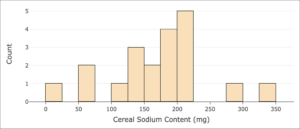
The histogram below displays the frequency of sodium content per serving for 20 different varieties of cereals.[2]
question 8
How many cereals have a sodium content of at least 200 milligrams (mg)?
question 9
According to the histogram, how many cereals have less than 200 mg?
Compare a single variable across groups using dotplots
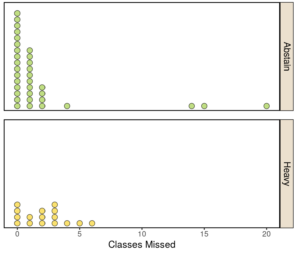
Now let’s make comparisons of a single variable across two groups. The following dotplots compare the numbers of classes missed between two groups of students: those who abstain from drinking alcohol (“Abstain”) and those who consume large amounts of alcohol each week (“Heavy”). Note that “Moderate” and “Light” drinkers are excluded here.
question 10
According to this graph, which group is larger: the number of students who abstain from drinking or the number of students who identify as “Heavy” drinkers?
question 11
Out of those students who abstain from drinking, how many have missed more than 5 classes?
question 12
How many students in total didn’t miss a single class?
Compare a single variable across groups using histograms
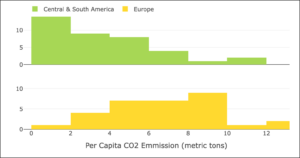
The following graph compares the distribution of per capita CO2 emissions between two groups: countries in Central and South America and countries in Europe.
question 13
How many European countries had CO2 emissions less than 4 metric tons?
question 14
Which group had more countries with CO2 emissions of at least 6 metric tons, Central and South America or Europe?
If you feel comfortable reading, interpreting, and comparing histograms, please move on to the next section and activity.
- Onyper, S. V., Thacher, P. V., Gilbert, J. W., & Gradess, S. G. (2012). Class start times, sleep, and academic performance in college: A path analysis. Chronobiology International, 29(3), 318-335. ↵
- Agresti, A., Franklin, C. A., & Klingenberg, B. (2021). Statistics: The art and science of learning from data, 5th edition. Pearson. https://www.pearson.com/us/higher-education/program/Agresti-My-Lab-Statistics-with-Pearson-e-Text-Access-Card-for-Statistics-The-Art-and-Science-of-Learning-from-Data-18-Weeks-5th-Edition/PGM2788191.html ↵