Question 1
In the preview assignment, you used a random number generator to run a chance experiment that involved selecting a number between 1 and 10 a total of 100 times (with replacement).

Credit: iStock/amitus
- How many times was 9 selected in your chance experiment?
- Did you get the same values as all of your classmates? Work with your instructor to sketch a dotplot of the results from all the students.
- Why do you think the results differed?
*missing objectives*
Organizers of a school carnival created a duck pond game consisting of 20 ducks floating in a small, artificial pond. Six of the ducks are designated as winners with a large dot on the bottom of each winning duck. To play the duck pond game, participants choose a duck and turn it over to discover if they chose a winning duck.
Every carnival attendee is allowed to play the game once for free. Participants can win a prize. Of the 20 ducks in the pond, two ducks are $10 winners, four ducks are $5 winners, and the rest of the ducks are not winners ($0).
Question 2
The following table shows prize winnings with the probabilities of winning each prize. Complete the table by computing the probabilities.
| Cash Prize | $10 | $5 | $0 |
| Probability of Winning |
Question 3
Make some predictions. If 100 people played the game:
- How many $10 prizes would the school give out?
- How many $5 prizes would the school give out?
- How many people would not win a prize ($0 prize)?
- How much money in prizes would the school award, in total?
Question 4
If 100 people played the game, what would be the prize awarded per game, on average?
Question 5
If 1,000 people played the game, what would be the prize awarded per game, on average?
Question 6
Let’s pretend that we are playing the game. Use the DCMP Random Number Generator. Let 1 and 2 represent the $10 prize ducks and let 3–6 represent the $5 prize ducks.
Direct link: https://dcmathpathways.shinyapps.io/RandomNumbers/
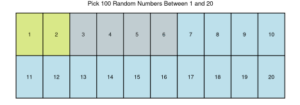
- Draw one duck. What did you win?
- What did your classmates win? Find the average amount that was won in your class.
- Was the average exactly $2? If not, was it close?
Question 7
Now let’s simulate playing the game 1,000 times. Again, let 1 and 2 represent the $10 prize ducks and let 3-6 represent the $5 prize ducks.
- In your class simulation, how much money was paid out by the school in prizes, in total and on average?
- Is the average prize award per game close to the value calculated from theoretical probability?
What we are seeing here is referred to as the Law of Large Numbers. The Law of Large Numbers says that as we increase the number of times we repeat a chance experiment, the closer we can expect the empirical probability calculated from our chance experiment to be to the true probability.
The Law of Large Numbers tells us that as the number of trials gets really large, the simulated probability based on the chance experiment and the true probability of the chance experiment will approach the same value.
Question 8
Suppose you are at the school carnival and your friend says, “Let’s go play the duck pond game right now because the last 10 kids did not win a prize. We are guaranteed to win!”
Is your friend correct?