Question 1
Think about what you know about DNA:

Credit: iStock/janiebros
- How would you describe DNA to a friend, and what is it useful for?
- What percentage of DNA do we share with our siblings? What about grandparents or cousins?
Question 2
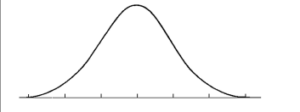
The average amount of DNA a person shares with a sibling is normally distributed with a mean of 50% and a standard deviation of 4%.[1] On the following graph, label each tick mark on the x-axis below with the mean, mean [latex]\pm 1[/latex] standard deviation, mean [latex]\pm 2[/latex] standard deviations, and mean [latex]\pm 3[/latex] standard deviations.
Question 3
Suppose you want to investigate the amount of DNA you share with your sibling. You are interested in determining how likely it is that no more than 56% of your DNA matches your sibling.
- Identify where 56% should be on the curve you labeled in Question 2, and then shade the area of the curve that represents the probability. Write a mathematical expression to describe the shaded area.
- Using your answer from Part a, estimate the probability (as a percentage) that your DNA matches no more than 56% of the DNA of your sibling. Choose the answer that is closest to the correct percentage.
- 5%
- 25%
- 50%
- 60%
- 90%
- Estimate the probability (as a percentage) that your DNA matches more than 56% of the DNA of your sibling. Choose the answer that is closest to the correct percentage.
- 5%
- 25%
- 50%
- 60%
- 90%
Question 4
The amount of DNA you share with a grandparent is normally distributed with an average of 25% and a standard deviation of 3%.
- Label the following graph with the mean, mean [latex]\pm 1[/latex] standard deviation, mean [latex]\pm 2[/latex] standard deviations, and mean [latex]\pm 3[/latex] standard deviations.
- Suppose you want to estimate the percentage of people who share less than 21% of their DNA with a grandparent. Label the curve at 21 and then shade the area of the curve that represents the probability. Write a mathematical expression describing the shaded area.
- Use technology to calculate the percentage of people who share less than 21% of their DNA with a grandparent. Follow these steps:
- Go to the DCMP Normal Distribution tool at https://dcmathpathways.shinyapps.io/NormalDist/.
- Click on the Find Probability tab at the top.
- Type in the mean and standard deviation given in the question.
- Choose lower tail: [latex]P(X < x)[/latex].
- Type in the value of [latex]x[/latex]. In this case, it will be 21.
- About what percentage of people would you expect share more than 21% of their DNA with a grandparent?
Question 5
The average amount of DNA you share with a first cousin is 12.5% with a standard deviation of 3.5%. What percentage of people do you expect share more than 19.5% of their DNA with their cousin? (Make sure to label and shade the following curve.
Question 6
Draw the curve from Question 5 again, and then draw a line where you think the top 1% would begin.
- Hint: The top 1% of the area of the curve should be shaded. Round to the nearest hundredth.
- We will now use technology to calculate the top 1%, which is also called the 99th percentile. The process is similar to how we found the probabilities in Questions 4 and 5, but instead of using the Find Probability tab, we will use the Find Percentile/Quantile tab since we are looking for a percentile. Round to the nearest hundredth.
- Go to the DCMP Normal Distribution tool at https://dcmathpathways.shinyapps.io/NormalDist/.
- Click on the Find Percentile/Quantile tab at the top.
- Type in the mean and standard deviation given in the question.
- Choose lower tail if we are looking for the bottom percent.
Choose upper tail if we are looking for the top percent. - Type in the probability in the lower tail/upper tail in % form.
- Some people share very little DNA with their first cousins. What percentage of DNA is shared by the lowest 1%? Round to the nearest hundredth.
Question 7
If someone shared 21% of their DNA with a relative, would you expect that relative to be a sibling, grandparent, or first cousin? Explain.
- International Society of Genetic Genealogy Wiki. (n.d.). Autosomal DNA statistics. https://isogg.org/wiki/Autosomal_DNA_ statistics ↵