Suppose you are testing whether a drug helps prevent a second heart attack within one year of a person’s first heart attack. Without the drug, 15% of people in a certain population have a second heart attack within one year of their first heart attack. Let [latex]p[/latex] denote the proportion of people in this population who take the drug and still have a second heart attack within a year.
Question 1
In your own words, describe the null hypothesis in the context of the problem.
Question 2
Write the null hypothesis in symbols, using the proper statistical notation.
Question 3
In your own words, describe the alternative hypothesis in the context of the problem.
Question 4
Write the alternative hypothesis in symbols, using the proper statistical notation.
You have learned that all hypothesis tests result in one of two actions: either you reject the null hypothesis in favor of the alternative OR you do not reject the null hypothesis. Thus, at the end of this drug study, you will choose one of the following:
- Reject the null hypothesis – There is evidence that the proportion of people taking the drug who have a second heart attack is less than 0.15. There is evidence the drug works!
- Do NOT reject the null hypothesis – There is not sufficient evidence to declare that the proportion of people taking the drug who have a second heart attack is less than 0.15. There is not sufficient evidence to say the drug works.
Consider a court system analogy[1]: a person on trial is assumed to be innocent, the default/null belief ([latex]H_{0}[/latex]), until proven guilty through evidence ([latex]H_{A}[/latex]).
There are two possible outcomes at the end of the trial:
- There is enough evidence to reject the person’s innocence (Reject [latex]H_{0}[/latex]).
- There is not enough evidence to reject the person’s innocence (Fail to Reject [latex]H_{A}[/latex]).
It is important to note that you cannot “accept [latex]H_{0}[/latex].” It’s assumed to be true already, so our research isn’t proving the null hypothesis. This is why a person is declared “not guilty” rather than “innocent” in court—their innocence was assumed at the beginning.
Question 5
In this study, a random sample of 75 heart attack patients was studied. Ten of the patients in the study suffered a second heart attack within one year of their first heart attack.
- What is the sample proportion? Use proper notation.
- It was determined that the conditions for a one-sample test of proportions were met. Given the output below, what can you conclude from the statistical results? Justify your answer.
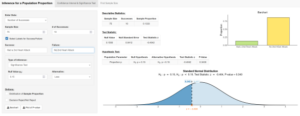
- Suppose the study researchers concluded that the new drug does not prevent a second heart attack after the first year. Can the researchers claim that the drug does not work?
- Skew the Script. (2021). AP® Statistics Lessons. https://skewthescript.org/ap-stats-curriculum ↵