Preparing for the next classIn the next in-class activity, you will need to be able to evaluate mathematical expressions by squaring numbers, taking the square root of numbers, and taking the logarithms of numbers. You will also need to describe trends in what happens to numbers when you square them, take their square roots, and take their logarithms.
Questions 1–5: We need to explore what happens when we square a number (raise it to the second power). For example, when we square the number 5, we get 52=5⋅5=25
Question 1
1) For each number in the table, calculate the square of that number. You may use a calculator.
| Original number |
1293 |
5 |
0 |
0.4 |
1 |
4.76 |
33 |
492.1 |
2084 |
| Number squared |
|
|
|
|
|
|
|
|
|
Question 2
2) If you were to order the list of squared numbers from least to greatest, would it be in the same order as the original list of numbers?
a) Yes
b) No
Question 3
3) Compare the numbers 4.76 and 2084. Which is greater—the distance between 4.76 and 2084 or the distance between 4.762 and 20842?
a)The distance between 4.76 and 2938
b) The distance between 4.762 and 20842
Go to the website https://www.desmos.com/calculator. To continue exploring how to square quantities, we will graph the line 𝑦=𝑥along with the graph of 𝑦=𝑥2.
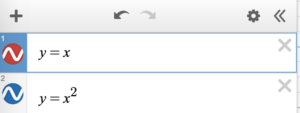
On the left-hand side of the screen, enter the equations 𝑦=𝑥and𝑦=𝑥2, as shown below. To write “𝑥2,” type “x^2” on your keyboard.
This will show the graphs of both equations.
Question 4
4) For values of 𝑥greater than 1, what happens to the distance between the graphsof 𝑦=𝑥and 𝑦=𝑥2as 𝑥gets larger (in other words, as we move to the right along the 𝑥-axis)?
a)As 𝑥gets larger, the distance between the graphsof 𝑦=𝑥and 𝑦=𝑥2stays the same.
b)As 𝑥gets larger, the distance between the graphs of 𝑦=𝑥and 𝑦=𝑥2gets larger.
c)As 𝑥gets larger, the distance between the graphsof 𝑦=𝑥and 𝑦=𝑥2gets smaller.
Question 5
5) Based on your answers to the questions about squaring numbers, which of the following is true?
a) For numbers greater than 1, squaring small numbers makes them a lot bigger and squaring big numbers makes them a little bigger.
b) For numbers greater than 1, squaring small numbers makes them a little bigger and squaring big numbers makes them a lot bigger.
c) For numbers greater than 1, squaring small numbers makes them a lot smaller and squaring big numbers makes them a little smaller.
d) For numbers greater than 1, squaring small numbers makes them a little smaller and squaring big numbers makes them a lot smaller.
Questions 6–10: Next, we will explore what happens when we take the square root of a number. A square root of a number is a value that, when multiplied by itself, gives the number. For example, 9 has two square roots: 3 and −3. When we use the symbol √, however, we mean the positive square root. Therefore, √9=3because 3⋅3 =9.
Question 6
6) For each number in the table, calculate the positive square root of that number. You may use a calculator. If necessary, round to three decimal places. If a value is undefined, write “UND.”
| Original number |
Positive square root of number |
| 1293 |
|
| 5 |
|
| 0 |
|
| 0.4 |
|
| 1 |
|
| 4.76 |
|
| 33 |
|
| 492.1 |
|
| 2084 |
|
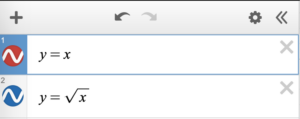
On https://www.desmos.com/calculator, enter the equations 𝑦=𝑥and 𝑦=√𝑥, as shown in the following graphic. For“√𝑥,” type “sqrtx” on your keyboard.
Question 7
7) Based on the graph of 𝑦=√𝑥and on the table in Question 6, what values of 𝑥can you take the square root of?
a) All real numbers
b) 𝑥<0c)𝑥≥0
Question 8
8) Compare the numbers 4.76 and 2084. Which is greater—the distance between 4.76 and 2084or the distance between √4.76and √2084?
a) The distance between 4.76 and 2084
b) The distance between √4.76and √2084
Question 9
9) For values of 𝑥greater than 1, what happens to the distance between the graphs of 𝑦=𝑥and 𝑦=√𝑥as 𝑥gets larger (in other words, as we move to the right along the 𝑥-axis)?
a) As 𝑥gets larger, the distance between the graphs of 𝑦=𝑥and 𝑦=√𝑥stays the same.
b) As 𝑥gets larger, the distance between the graphs of 𝑦=𝑥and 𝑦=√𝑥gets larger.
c) As 𝑥gets larger, the distance between the graphsof 𝑦=𝑥and 𝑦=√𝑥gets smaller.
Question 10
10) Based on your answers to questions about taking the square root of a number, which of the following is true?
a) For numbers greater than 1, taking the square roots of small numbers makes them a lot bigger and taking the square rootsof big numbers makes them a little bigger.
b) For numbers greater than 1, taking the square rootsof small numbers makes them a little bigger and taking the square rootsof big numbers makes them a lot bigger.
c) For numbers greater than 1, taking the square rootsof small numbers makes them a lot smaller and taking the square rootsof big numbers makes them a little smaller.
d) For numbers greater than 1, taking the square rootsof small numbers makes them a little smaller and taking the square rootsof big numbers makes them a lot smaller.
Questions 11–15: Finally, we will explore what happens when we take the logarithm of a number. A logarithm answers the question, “To what power must we raise one number to get another number?” For example, consider the question,“To what power must we raise 2 to get 8?” We see that
2 ∙2 ∙2 =23=8
So, the answer to our question is 3. The way we write this logarithm is
log2(8)= 3
and in fact, the statements
23=8and log2(8)=3
contain the same information. In general, the statements
𝑏𝑥=𝑎 and log𝑏(𝑎)=𝑥
contain the same information. In both the exponential form and the logarithmic form, the quantity 𝑏is called the base. A base that is often used in logarithms is 10; instead of writing log10(𝑎), we often just write log(𝑎).Another common base that you may encounter is the irrational number 𝑒, which is approximately equal to 2.718; instead of writing log𝑒(𝑎), we often just write ln(𝑎)and call this the “natural logarithm of 𝑎.”
Question 11
11) For each number in the following table, calculate the base10 logarithm of that number. (On a calculator, use the button labeled “log” or “LOG.”) If necessary, round to three decimal places. If a value is undefined, write “UND.”
| Original number |
Base 10 logarithm |
| 1293 |
|
| 5 |
|
| 0 |
|
| 0.4 |
|
| 1 |
|
| 4.76 |
|
| 33 |
|
| 492.1 |
|
| 2084 |
|
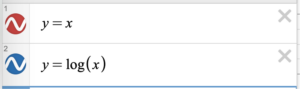
On https://www.desmos.com/calculator, enter the equations 𝑦=𝑥and 𝑦=log(𝑥), as shown in the following graphic.
Question 12
12) Based on the graph of 𝑦=log(x)and on the table in Question 11, what values of 𝑥can you take the base 10 logarithm of?
a) All real numbers
b) 𝑥≤0
c) 𝑥>0
Question 13
13) Compare the numbers 4.76 and 2084. Which is greater—the distance between 4.76 and 2084or the distance between log(4.76) and log(2084)?
a) The distance between 4.76 and 2084
b) The distance between log(4.76)and log(2084)
Question 14
14) For values of 𝑥greater than 1, what happens to the distance between the graphs of 𝑦=𝑥and 𝑦=log(𝑥)as 𝑥gets larger (in other words, as we move to the right along the 𝑥-axis)?
a) As 𝑥gets larger, the distance between the graphs of 𝑦=𝑥and 𝑦=log(𝑥)stays the same.
b) As 𝑥gets larger, the distance between the graphs of 𝑦=𝑥and 𝑦=log(𝑥)gets larger.
c) As 𝑥gets larger, the distance between the graphs of 𝑦=𝑥and 𝑦=log(𝑥)gets smaller.
Question 15
15) Based on your answers to the previous two questions, which of the following is true?
a) For numbers greater than 1, taking the base10 logarithm of small numbers makes them a lot bigger and taking the base10 logarithm of big numbers makes them a little bigger.
b) For numbers greater than 1, taking the base10logarithm of small numbers makes them a little bigger and taking the base10 logarithm of big numbers makes them a lot bigger.
c) For numbers greater than 1, taking the base10 logarithm of small numbers makes them a lot smaller and taking the base10 logarithm of big numbers makes them a little smaller.
d) For numbers greater than 1, taking the base10 logarithm of small numbers makes them a little smaller and taking the base10 logarithm of big numbers makes them a lot smaller.