
4A

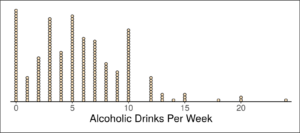
A dot plot showing the average number of Alcoholic drinks consumed per week by college students. A count of 33 students drank 0. A count of 9 students drank 1. A count of 16 students drank 2. A count of 30 students drank 3. A count of 18 students drank 4. A count of 31 students drank 5. A count of 23 students drank 6. A count of 22 students drank 7. A count of 14 students drank 8. A count of 11 students drank 9. A count of 26 students drank 10. Zero students drank 11. A count of 9 students drank 12. A count of 3 students drank 13. One student drank 14. A count of 3 students drank 15. One student drank 18. A count of 2 students drank 20. One student drank 24.
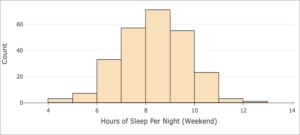
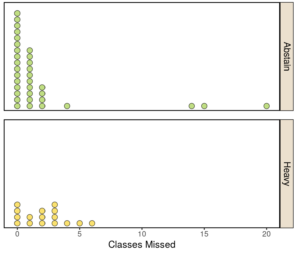
A histogram of labeled "Hours of Sleep Per Night (Weekend)" on the x-axis and "Count" on the y-axis. For 4-5, the count is approximately 4. For 5-6, the count is approximately 8. For 6-7, the count is approximately 33. For 7-8, the count is approximately 57. For 8-9, the count is approximately 70. For 9-10, the count is approximately 54. For 10-11, the count is approximately 23. For 11-12, the count is approximately 4. For 12-13, the count is approximately 2. Two dot plots are shown. In the first, it shows the number of classes missed by students who abstain from drinking alcohol. 16 students missed 0 classes. 10 students missed 1 class. 4 students missed 2 classes. One student missed 4 classes. One student missed 14 classes. One student missed 15 classes. One student missed 20 classes. The second dot plot shows the number of classes missed by students who drink heavily. 4 students missed 0 classes. 2 students missed 1 class. 3 students missed 2 classes. 4 students missed 3 classes. 1 student missed 4 classes. 1 student missed 5 classes. 1 student missed 6 classes.

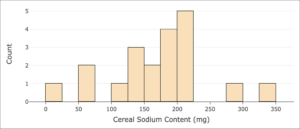
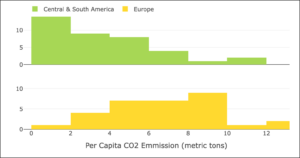
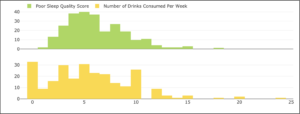
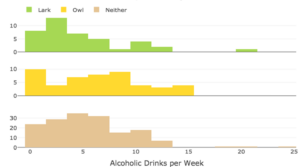
A histogram labeled "Cereal Sodium Content (mg)" on the horizontal axis, which is numbered in increments of 50 from 0 to 100, and labeled "Count" on the vertical axis. For 0-25, the count is 1. For 50-75, the count is 2. For 100-125, the count is 1. For 125-150, the count is 3. For 150-175, the count is 2. For 175-200, the count is 4. For 200-225, the count is 5. For 275-300, the count is 1. For 325-350, the count is 1. Two histograms are shown. In the first histogram, it shows the per capita CO2 Emission in metric tons (x-axis) and the number of Central and South American countries that produce those amounts of emissions. 14 countries emitted between 0 and 2 metric tons. 9 countries emitted between 2 and 4 metric tons. 8 countries emitted between 4 and 6 metric tons. 4 countries emitted between 6 to 8 metric tons. 1 country emitted between 8 and 10 metric tons. 2 countries emitted between 10 and 12 metric tons. In the second histogram, it shows the per capita CO2 Emission in metric tons (x-axis) and the number of European countries that produce those amounts of emissions. 1 country emitted between 0 and 2 metric tons. 4 countries emitted between 2 and 4 metric tons. 7 countries emitted between 4 and 6 metric tons. 7 countries emitted between 6 and 8 metric tons. 9 countries emitted between 8 and 10 metric tons. 1 country emitted between 10 and 12 metric tons. 2 countries emitted 12 or more metric tons. A young man resting his head on his arms on his desk, sleeping in a classroom. Other students in the background are awake and working at their desks. Two histograms. Above them, there is a legend showing that green indicates Poor Sleep Quality Score and yellow indicates Number of Drinks Consumed Per Week. The first histogram is green. For 1, the count is approximately 2. For 2, the count is approximately 13. For 3, the count is approximately 25. For 4, the count is approximately 38. For 5, the count is approximately 40. For 6, the count is approximately 36. For 7, the count is approximately 20. For 8, the count is approximately 27. For 9, the count is approximately 19. For 10, the count is approximately 10. For 11, the count is approximately 11. For 12, the count is approximately 4. For 13, the count is approximately 2. For 14, the count is approximately 2. For 15, the count is approximately 3. For 18, the count is approximately 1. The second chart is yellow. For 0, the count is approximately 33. For 1, the count is 9. For 2, the count is approximately 15. For 3, the count is approximately 30. For 4, the count is approximately 17. For 5, the count is approximately 30. For 6, the count is approximately 22. For 7, the count is approximately 21. For 8, the count is approximately 13. For 9, the count is approximately 10. For 10, the count is approximately 26. For 12, the count is approximately 9. For 13, the count is approximately 3. For 14, the count is approximately 1. For 15, the count is approximately 3. For 18, the count is approximately 1. For 20, the count is approximately 2. For 24, the count is approximately 1. Three histograms, labeled "Alcoholic Drinks per Week" on the horizontal axis. At the top, there is a legend showing that green indicates lark, yellow indicates owl, and brown indicates neither. The first chart is green. For 0-1, the count is approximately 8. For 2-3, the count is approximately 13. For 4-5, the count is approximately 7. For 6-7, the count is approximately 5. For 8-9, the count is approximately 1. For 10-11, the count is approximately 4. For 12-13, the count is approximately 2. For 20-21, the count is approximately 1. The next plot is yellow. For 0-1, the count is approximately 10. For 2-3, the count is approximately 4. For 4-5, the count is approximately 7. For 6-7, the count is approximately 8. For 8-9, the count is approximately 9. For 10-11, the count is approximately 4. For 12-13, the count is approximately 3. For 14-15, the count is approximately 4. The next chart is brown. For 0-1, the count is approximately 23. For 2-3, the count is approximately 29. For 4-5, the count is approximately 33. For 6-7, the count is approximately 30. For 8-9, the count is approximately 14. For 10-11, the count is approximately 19. For 12-13, the count is approximately 8.

Poor Sleep Quality Score Alcoholic Drinks Per Week
Mean Median Mean Median
Owl
Lark
Neither
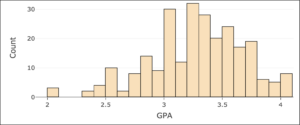
A histogram labeled "GPA" on the x-axis and "Count" on the y-axis. For 2-2.1, the count is approximately 3. For 2.3-2.4, the count is approximately 2. For 2.4-2.5, the counts is approximately 4. For 2.5-2.6, the count is approximately 10. For 2.6-2.7, the count is approximately 2. For 2.7-2.8, the count is approximately 8. For 2.8-2.9, the count is approximately 14. For 2.9-3.0,, the count is approximately 9. For 3.0-3.1, the count is approximately 30. For 3.1-3.2, the count is approximately 12. For 3.2-3.3, the count is approximately 32. For 3.3-3.4, the count is approximately 28. For 3.4-3.5, the count is approximately 20. For 3.5-3.6, the count is approximately 24. For 3.6-3.7, the count is approximately 17. For 3.7-3.8, the count is approximately 19. For 3.8-3.9, the count is approximately 6. For 3.9-4.0, the count is approximately 5. For 4.0-4.1, the count is approximately 8.


  Mean Median
Owl 4.24 2
Lark 1.57 1
Class Mean Median
Freshman (Year 1)
Sophomore (Year 2)
Junior

(Year 3)

Senior

(Year 4)

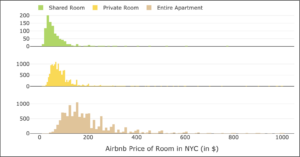
Three histograms side by side. The horizontal axis is labeled "Airbnb Price of Room in NYC (in $)" and numbered in increments of 200 from 0 to 1000. Above the graphs, there is a legend showing that green indicates a shared room, yellow indicates a private room, and brown indicates an entire apartment. The first chart is green and it is skewed to the left, with a high point at approximately 40 on the horizontal axis with a count of 200. The next graph is yellow and is also skewed to the left, though less so than the previous graph. Its high point is at approximately 60 on the horizontal axis and its count is approximately 1050. The next graph is brown and also skewed to the left, though less than either of the previous. Its high point is at approximately 160 on the horizontal axis, with a count of approximately 1050.

Group Mean Median
Central and South America
Europe

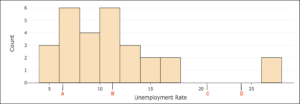
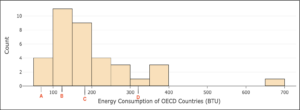
A histogram labeled "Unemployment Rate" on the x-axis and "Count" on the y-axis. For 4-6, the count is 3. For 6-8, the count is 6. For 8-10, the count is 4. For 10-12, the count is 6. For 12-14, the count is 3. For 14-16, the count is 2. For 16-18, the count is 2. For 26-28, the count is 2. The graph is marked "A" at approximately 6.4, "B" at approximately 11.2, "C" at approximately 21.3, and "D" at approximately 24.3. A histogram labeled "Energy Consumption of OECD Countries (BTU)" on the horizontal axis and "Count" on the vertical axis. For 50-100, the count is 4. For 100-150, the count is 11. For 150-200, the count is 9. For 200-250, the count is 4. For 250-300, the count is 3. For 300-350, the count is 1. For 350-400, the count is 3. For 650-700, the count is 1. On the horizontal axis, there are several labels. It reads "A" at approximately 70, "B" at approximately 125, "C" at approximately 180, and "D" at approximately 320.

Group Mean Median
Owl
Lark
Neither

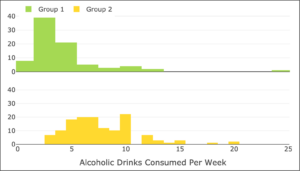
Two histograms. The horizontal axis is labeled "Alcoholic Drinks Consumed Per Week." At the top, a legend shows that green indicates Group 1 and yellow indicates Group 2. The first graph is green. For 1-2, the count is approximately 8. For 3-4, the count is approximately 39. For 5-6, the count is approximately 20. For 7-8, the count is approximately 4. For 9-10, the count is approximately 3. For 11-12, the count is approximately 4. For 13-14, the count is approximately 2. For 24-25, the count is approximately 1. The next graph is yellow. For 3, the count is approximately 7. For 4, the count is approximately 10. For 5, the count is approximately 18. For 6-7, the count is approximately 20. For 8, the count is approximately 11. For 9, the count is approximately 10. For 10, the count is approximately 22. For 12, the count is approximately 7. For 13, the count is approximately 3. For 14, the count is approximately 1. For 15, the count is approximately 3. For 18, the count is approximately 1. For 20, the count is approximately 2.

Skill or Concept: I can . . . Questions to check your understanding Rating
from 1 to 5
Calculate the mean and median of a dataset by hand, as well as with technology. 1, 2
Calculate the mean and median for multiple groups using technology. 4
Estimate the mean and median by looking at the data presented in a histogram. 3, 5

Glossary

mean
the arithmetic mean of a list of numbers, commonly called the “average”.
median
the “middlemost” number.