11E/F

Reject the null hypothesis Do not reject the null hypothesis
Null hypothesis is correct Type I error No error
Null hypothesis is incorrect No error Type II error
Sample Size Sample Proportion P-value
Question 1
Question 4
Skill or Concept: I can . . . Questions to check your understanding Rating
from 1 to 5
Identify statistical significance. 2
Identify practical significance. 3
Describe the factors that affect the size of the P-value. 4–6

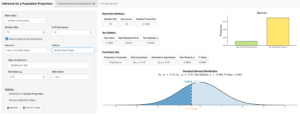
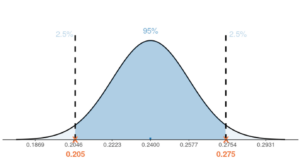
A visualization. At the top, “Inference for a Population Proportion” has been selected and “Confidence Interval & Significance Test” and “Find Sample Size” are both unselected. Beneath, there is a heading that reads “Enter Data,” and “Number of Successes” has been selected from a dropdown beneath it. Next is a heading that reads “Sample Size” and 75 has been input for it. Beside that is a heading reading “# of Successes,” for which 10 has been input. Beneath these is a checkbox that has been selected that reads “Select Labels for Success/Failure.” The next heading reads “Success” and there is an input box beneath it that has “Had a 2nd Heart Attack” written in it. Beside this is another heading “Failure” and there is an input box beneath that reading “No 2nd Heart Attack.” The next heading reads “Type of Inference” and “Significance Test” has been selected from the dropdown. Beneath this is a heading reading “Null Value p sub zero” and it reads 0.15 in the box below. To the right of it is another heading reading “Alternative” and “Less” has been selected from the dropdown beneath it. The next heading reads “Options” and there are two unselected checkboxes below this, “Distribution of Sample Proportion” and “Decision Reject/Not Reject.” Beneath these are two buttons, one reading “Barchart” and the other reading “Plot of P-value.” To the right of all this is two graphs and several tables. There is a heading reading “Descriptive Statistics” and a table beneath it with three columns. The first column is labeled “Sample Size” and it reads 75. The next column is labeled “Successes” and it reads 10. The last column is labeled “Sample Proportion” and it reads 0.1333. The next heading reads “Test Statistic” and also has a table beneath it with three columns. The first column is labeled “Null Value” and reads 0.1500, the next is labeled “Null Standard Error” and reads 0.0412, and the last one is labeled “Test Statistic z” and reads -0.4042. There is another heading below this reading “Hypothesis Test” and then a table with 5 columns. The first column is labeled “Population Parameter” and reads “Proportion p,” the second Is labeled “Null Hypothesis” and reads “H sub zero, p equal 0.15,” the third is labeled “Alternative Hypothesis” and reads “H sub a is less than 0.15,” the fourth is labeled “Test Statistic z” and reads -0.4042, and the last is labeled “P-Value” and reads 0.3430. To the right of the tables is a Barnhart labeled “Proportion” on the y-axis and numbered in increments of 0.25. For “Has a 2nd Heart Attack,” the value Is approximately 0.13. For “No 2nd Heart Attack,” the value is approximately 0.87. Beneath the bar chart and the tables is another graph showing curve. It is labeled “Standard Normal Distribution,” under which more text reads “H sub zero: p = 0.15, H sub a: p is less than 0.15. Test Statistic: z = -0.404, P-value = 0.343.” It shows a curve centered at approximately 0 labeled in increments of 1. There is a vertical line at z = -0.404. The area under the curve to the left of the line is shaded and labeled 0.343. The area to the right under the curve is labeled 0.657. A woman looking out a window. A curve with a peak centered on 0.2400 and numbered in increments of 0.0177. There are vertical lines at 0.205 and 0.275. Outside of each line is labeled 2.5%. The area under the curve between the lines is shaded and labeled 95%.

Commonly-White Names Commonly-Black Names Total
Called back 246 164 410
Not called back 2,199 2,281 4,480
Total 2,445 2,445 4,890
Group Sample Size Successes Sample Proportion
Female 1,233 1,026 0.8321
Male 1,009 757 0.7502
Skill or Concept: I can . . . Questions to check your understanding Rating
from 1 to 5
Distinguish between situations that require a one-sample test of proportions or a two-sample test of proportions. 1–4
Set up the hypotheses for a two-sample test of proportions. 5

A poster reading "join our team, we are hiring." In a corner, it reads "Send us your CV, yourwebsite.com." A curve with a peak centered on 0.2400 and numbered in increments of 0.0177. There are vertical lines at 0.205 and 0.275. Outside of each line is labeled 2.5%. The area under the curve between the lines is shaded and labeled 95%. An unlabeled number line

Glossary 11E

type I error
rejection of a correct null hypothesis.
type II error
not rejecting a null hypothesis that is actually incorrect.
statistical significance
having enough evidence against the null hypothesis to convince us to reject the null hypothesis.
practical significance
having results that are meaningful

Glossary 11F

two-sample test of proportions
a test that tests a claim about two population proportions.