16C/D

Skill or Concept: I can . . . Questions to check your understanding Rating
from 1 to 5
Use technology to calculate a regression equation. 1
Calculate predictions from the regression line. 2
Use technology to calculate confidence intervals for the mean response and prediction intervals for individuals. 3
Identify the appropriate type of interval based on a given situation. 4
Compare confidence and prediction intervals. 5

Someone riding a bike on a road in the countryside

Exponent Exponential expression Equivalent expression using multiplication and division Evaluated expression
4 2  2  2 2 16
3
2
1
0
1
2
3
4
Original number 1293 5 0 0.4 1 4.76 33 492.1 2084
Number squared
Original number Positive square root of number
1293
5
0
0.4
1
4.76
33
492.1
2084
Original number Base 10 logarithm
1293
5
0
0.4
1
4.76
33
492.1
2084
Skill or Concept: I can . . . Questions to check your understanding Rating
from 1 to 5
Evaluate mathematical expressions by squaring numbers, taking the square roots of numbers, and taking the logarithms of numbers. 1, 6, 11
Describe trends in what happens to numbers when you square them, take their square roots, and take their logarithms. 2–5, 7–10,

12–15

A dot plot labeled “Income per Person (in 2011, international dollars),” with the x-axis labeled in increments of 10000. The graph is significantly skewed to the left. Albania is marked at approximately 12000, the USA is marked at approximately 56000, Singapore is marked at approximately 91000, and Qatar is marked at approximately 113000.

the labels have not transferred with the image

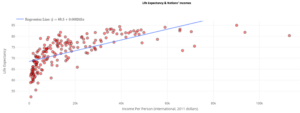
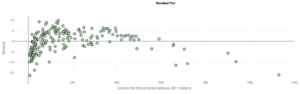
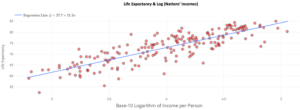
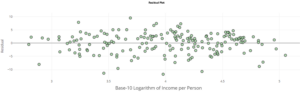
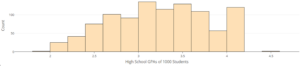
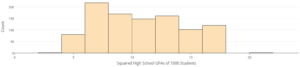
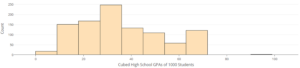
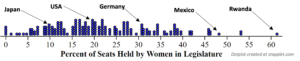
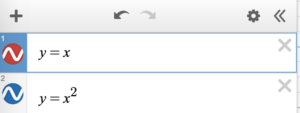
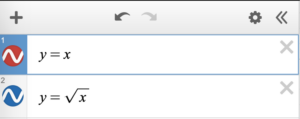
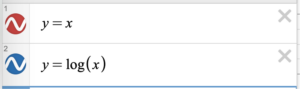
Figurines of golfers on tall stacks of coins next to shorter stacks of coins with figurines of construction workers on them. A scatterplot titled “Life Expectancy & Nations’ Incomes.” It is labeled “Income Per Person (international, 2011 dollars)” on the x-axis and “Life Expectancy” on the y-axis. There is a line whose slope is given as “Regression Line: y =68.5 + 0.000245x.” A residual plot labeled “Income Per Person (international, 2011 dollars)” on the x-axis and “Residual” on the y-axis. There is a horizontal line at y = 0. There are more points for lower x-values and both lower x-values and higher x-values are more likely to be below the horizontal line. A dot plot titled “Square Root of Incomes per Person.” There are more dots on the left than on the right, although it is less skewed than the data was in the previous dot pot. A dot plot titled “Log base ten of Nations’ Incomes.” The dots are spread relatively evenly across the dot plot. A scatterplot titled “Life Expectancy & Nations’ Incomes.” It is labeled “Base-10 Logarithm of Income Per Person“ on the x-axis and “Life Expectancy” on the y-axis. There is a line whose slope is given as “Regression Line: y = 27.7 + 11.3x.” A residual plot labeled “Base-10 Logarithm of Income Per Person” on the x-axis and “Residual” on the y-axis. There is a horizontal line at y = 0. There does not appear to be a pattern to the points. A histogram labeled “High School GPAs of 1000 Students” on the x-axis and “Count” on the y-axis. For 1.8-2, the count is approximately 5. For 2-2.2, the count is approximately 25. For 2.2-2.4, the count is approximately 45. For 2.4-2.6, the count is approximately 75. For 2.6-2.8, the count is approximately 100. For 2.8-3, the count is approximately 90. For 3-3.2, the count is approximately 135. For 3.2-3.4, the count is approximately 115. For 3.4-3.6, the count is approximately 130. For 3.6-3.8, the count is approximately 110. For 3.8-4, the count is approximately 55. For 4-4.2, the count is approximately 120. For 4.4-4.6, the count is approximately 5. A histogram labeled “Squared High School GPAs of 1000 Students” on the x-axis and “Count” on the y-axis. For 2-4, the count is approximately 5. For 4-6, the count is approximately 80. For 6-8, the count is approximately 220. For 8-10, the count is approximately 170. For 10-12, the count is approximately 150. For 12-14, the count is approximately 160. For 14-16, the count is approximately 100. For 16-18, the count is approximately 120. For 20-22, the count is approximately 5. A histogram labeled “Cubed High School GPAs of 1000 Students” on the x-axis and “Count” on the y-axis. For 0-9, the count is approximately 20. For 9-18, the count is approximately 150. For 18-27, the count is approximately 170. For 27-36, the count is approximately 250. For 36-45, the count is approximately 140. For 45-54, the count is approximately 120. For 54-63, the count is approximately 60. For 63-72, the count is approximately 125. For 90-99, the count is approximately 5. A dotplot labeled “Percent of Seats Held by Women in Legislature” and numbered from 0 to 60. There are more points on the left side than the right. Japan is labeled at approximately 10, USA is labeled at approximately 19, Germany is labeled at approximately 31, Mexico is labeled at approximately 48, and Rwanda is labeled at approximately 62. A dotplot labeled “Percent of Seats Held by Women in Legislature” and numbered from 0 to 7. There are slightly more points on the left side. The desmos graphing calculator interface. In the first equation space, "y = x" has been written. In the second, "y = x squared" has been written. The first equation has a red curve symbol next to it and the second has a blue curve symbol next to it. The desmos graphing calculator interface. In the first equation space, "y = x" has been written. In the second, "y = the square root of x" has been written. The first equation has a red curve symbol next to it and the second has a blue curve symbol next to it. The desmos graphing calculator interface. In the first equation space, "y = x" has been written. In the second, "y = log of x" has been written. The first equation has a red curve symbol next to it and the second has a blue curve symbol next to it.

Glossary 16C

confidence interval for the mean response
a range of plausible values the mean value of the response variable takes when 𝑥 = 𝑥0.
𝑪% prediction interval for an individual response
a range of plausible values of the response when an individual observation has a value of the explanatory variable equal to 𝑥0.

Glossary 16D

base
the number that is multiplied in an exponent.
exponent
the number of times to multiply the base by itself.
squaring
multiplying a number by itself once.
cubing
multiplying a number by itself twice.
unit fraction
a fraction whose numerator is 1 and whose denominator is a positive integer.