18D Preview

Preparing for the next class
In the next in-class activity, you will need to identify observational units and types of variables, describe how to simulate the random assignment of treatments to experimental groups, and determine whether data provide evidence against a null hypothesis based on a simulated null distribution of sample statistics. From 2005 to 2015, the proportion of children allergic to peanuts doubled in Western countries. However, the allergy is not very common in some other countries where peanut protein is an important part of peoples’ diets. The Learning Early about Peanut Allergy (LEAP) randomized trial, reported by Du Toit and others in TheNew England Journal of Medicine in February 2015, identified over 500 children ages four to 10 months who showed some sensitivity to peanut protein.[1] They randomly assigned them to two groups:
•Peanut avoiders: Parents were told to not give their kids any foods which contained peanuts
•Peanut eaters: Parents were given snacks containing peanut protein and were told to feed it to their children several times per week (target dose was at least six grams of peanut protein per week) The researchers tracked the children for five years and then recorded whether the children had developed peanut allergies by age five. They hoped to show that feeding children peanut protein at an early age helps prevent peanut allergies.

Question 1

1) What are the observational units in this study?

Question 2

2) Identify the variables measured on each observational unit. For each variable, state if it is categorical or quantitative and state whether it is an explanatory variable or aresponse variable.

Question 3

3) Of the 245 infants getting peanut protein, fiveshowed allergic symptoms to peanuts at age five;whereas in the peanut avoidance group, 35 of the 255 infants developed allergic symptoms to peanuts. (The two groups started with equal, somewhat larger numbers of infants, but there were dropouts who are not included in this analysis.) Summarize these results by filling in thefollowing2×2 table.

Peanut avoiders Peanut eaters Total
Allergic
Not allergic
Total

Question 4

4) Denote the sample proportion of peanut avoiders who developed peanut allergiesby 𝑝1̂and the proportion of peanut eaters whodeveloped peanut allergiesby 𝑝2̂. Find the values of 𝑝1̂and 𝑝2̂andthen calculate the difference in proportions, 𝑝1̂−𝑝2̂.

Question 5

5) Assume that feeding children peanut protein at an early age does nothelp prevent peanut allergies, and the 40 children who developed peanut allergies in the study would have developed them regardless of eating peanut protein at an early age or not. Suppose we represent our sample of 500 children with 500 cards, 40 labeled“allergic” and 460 labeled “not allergic.”
Part A: Describe how you would use the cards to randomly assign children to the two groups: 255 peanut avoiders and 245 peanut eaters.
Part B: Under the assumption that feeding children peanut protein at an early age does nothelp prevent peanut allergies, what would you expect the value of 𝑝1̂−p2̂to be if you calculated the difference in proportionsof children with peanut allergies in your simulated sample? Explain.

Question 6

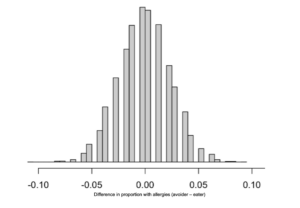
6) Using the process described in Question 5, Part A, a computer generated 1,000 different random assignments of the 500 children to the two groups. A plot of the simulated differences in proportion of children with allergies is shown below.This plot is called a simulated null distributionof differences in sample proportions.
A graph labeled “Difference in proportion with allergies (avoider - eater)” and numbered in increments of 0.05 from -0.10 to 0.10. It shows a peak around 0.00 and decreases to near zero around -0.10 and 0.10.
Part A: Where does the observed difference in sample proportionsof children with allergies between the two groups (calculated in Question 4) lie on the previous plot?
Part B: Based on your answer in Part A, do these data provide evidence that feeding children peanut protein at an early age helps prevent peanut allergies? Explain your reasoning based on thesimulation results, including a discussion of the purpose of the simulation process and what information it revealed to help you answer this research question.
Hint: What did we assume when we simulated the 1,000 random assignments?

  1. Du Toit, G.,Roberts, G., Sayre, P. H., Bahnson, H. T., Radulovic, S., Santos, A. F., Brough, H. A., Phippard, D., Basting, M., Feeney, M., Turcanu, V., Sever, M. L., Lorenzo, M. G., Plaut, M., & Lack, G. (2015, February 26). Randomized trial of peanut consumption in infants at risk for peanut allergy. The New England Journal of Medicine, 372(9),803–813.https://www.nejm.org/doi/full/10.1056/NEJMoa1414850