4B

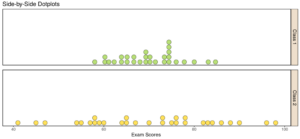
Two dot plots of exam scores. One shows dots clustered primarily between 60 and 80, while the other shows dots spread out between 40 and 100.

Hurricane Damage (in millions of dollars)

 ()

Deviation from the Mean (in millions of dollars)
105,840
45,561
27,790
20,587
19,832
15,820
12,775
11,797
11,760
11,227

A mom and two children looking at a tablet together and smiling

Rating Mean Median Standard Deviation Variance
G
R

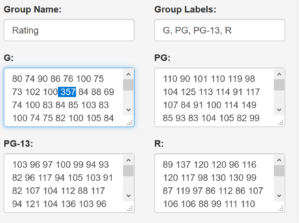
A selection menu, showing headings "Group Name," "Group Labels," "G," "PG," "PG-13," and "R." In the "G" section, 357 is highlighted.

Rating Mean Median Standard Deviation Variance
G rating with the outlier
G rating without the outlier

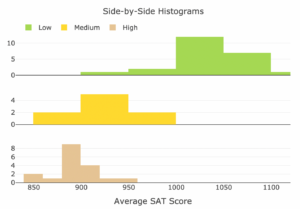
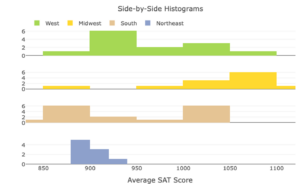
Three side-by-side histograms. The horizontal axis is labeled "Average SAT Score" and numbered in increments of 50 from 850 to 1100. There is a legend showing that green corresponds to low, yellow to medium, and brown to high. The first histogram is green. For 900 to 950, the count is approximately 1. For 950 to 1000, it is approximately 2. For 1000 to 1050, it's approximately 12. For 1050 to 1100, it is approximately 7, and for above 1100, it is approximately 1. The next histogram is yellow. For 850 to 900, the count is 2. For 900 to 950, it is approximately 5. For 950 to 1000, it is 2. The next histogram is brown. For 850 to 867, the count is 2. For 867 to 883, the count is 1. For 883 to 900, the count is 9. For 900 to 917, the count is 4. For 917 to 933, the count is 1. For 933 to 950, the count is 1. Four side-by-side histograms, labeled "Average SAT Scores." On the horizontal axis, it is labeled in increments of 50 from 850 to 1100. There is a legend showing green indicates West, yellow indicates Midwest, brown indicates South, and purple indicates Northeast. For the green histogram, from 850 to 900, the count is 1. From 900 to 950, the count is 6. From 950 to 1000, the count is 2. For 1000 to 1050, the count is 3. For 1050 to 1100, the count is 1. For the purple histogram, from 883 to 900, the count is 5. For 900 to 917, the count is 3, For 917 to 933, the count is 1.

Region Mean Median Standard Deviation Variance
West
Midwest
South
Northeast


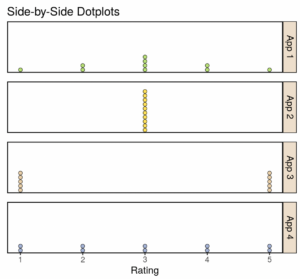
Four side by side dot plots with the horizontal axis labeled "Rating," numbered in increments of 1 from 1 to 5. The first plot is labeled App 1. For rating 1, there is 1 dot. For rating 2, there are 2 dots. For rating 3, there are 3 dots. For rating 4, there are 2 dots. For rating 5, there is 1 dot. The next plot is titled App 2. For rating 3, there are 10 dots. The next graph is titled App 3. For rating 1, there are 5 dots. For rating 5, there are 5 dots. The next plot is titled App 4. For every rating, there are two dots.

Skill or Concept: I can . . . Questions to check your understanding Rating
from 1 to 5
Visually assess the differences in variability, given comparative histograms or dotplots. 1, 2
Understand the summary statistics feature of the Describing and Exploring Quantitative Variables tool. 3, 4
Use technology to calculate measures of variability: standard deviation, variance, and range. 5–7

Glossary

deviation from the mean
the distance between an observation (x) in a dataset and the mean (x¯) of the dataset.
variability
a measure of how dispersed (spread out) the data are. It is often referred to as the spread, or dispersion, of a dataset.
standard deviation
a measure of how spread out observations are from the mean.
σ
the standard deviation of a population of observations.
s
the standard deviation of a sample of observations.
variance
the standard deviation squared.
σ2
the variance of a population of observations.
s2
the variation of a sample of observations.
range
the maximum (or largest) value – the minimum (or smallest) value.