| Skill or Concept: I can . . . | Questions to check your understanding | Rating from 1 to 5 |
| Convert values into standardized scores. | 1–4 | |
| Use a value’s standardized score to determine whether the value is above, below, or equal to the mean. | 4 | |
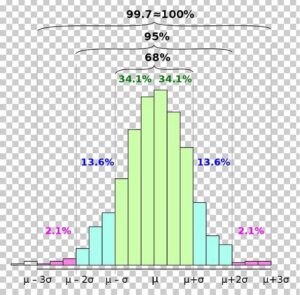
| Explain the Empirical Rule. | 5 |

Glossary
- standardized value
- the number of standard deviations an observation is away from the mean. Also referred to as a z-score.
- Empirical Rule
- a guideline that predicts the percentage of observations within a certain number of standard deviations. Also known as the 68-95-99.7 Rule which states that in a bell-shaped, unimodal distribution, almost all of the observed data values, , lie within three standard deviations, , to either side of the mean, . More specifically, about 68% of observations in a dataset will be within one standard deviation of the mean , about 95% of the observations in a dataset will be within two standard deviations of the mean , and about 99.7% of the observations in a dataset will be within three standard deviations of the mean .