Question 1
1) Do you get an annual flu vaccine? Do you think available vaccines are definitely safe? Probably safe? Probably unsafe? Or definitely unsafe? Explain.
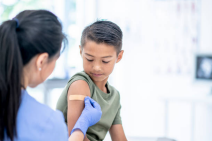
Credit: iStock/FatCamera
Question 2
2) In May 2021, SurveyUSA interviewed 750 California adults and asked a number of vaccine-related questions. The survey respondents were considered representative of California adults. One of the questions asked was: “Based on what you know, are the currently available Coronavirus vaccines definitely safe? Probably safe? Probably unsafe? Or definitely unsafe?”
The results are reported in the following table:
What is your political party affiliation?
| Republican | Democrat | Independent | None | Total | ||
| Based on
what you know, are the currently available Coronavirus vaccines… |
Definitely Safe | 61 | 149 | 49 | 19 | 278 |
| Probably Safe | 61 | 142 | 62 | 28 | 293 | |
| Probably
Unsafe |
25 | 14 | 26 | 18 | 83 | |
| Definitely
Unsafe |
16 | 17 | 10 | 2 | 45 | |
| Not Sure | 17 | 16 | 18 | 0 | 51 | |
| Total | 180 | 338 | 165 | 67 | 750 |
- What is the probability that a randomly selected California adult believes that the Coronavirus vaccine is definitely safe? Round to the nearest thousandth.
- What is the probability that a randomly selected California adult’s political party affiliation is Republican? Round to the nearest thousandth.
- What is the probability that a randomly selected California adult does not believe that the Coronavirus vaccine is definitely safe? Round to the nearest thousandth.
- What is the probability that a randomly selected California adult believes that the Coronavirus vaccine is definitely safe AND their political party affiliation is Republican? Round to the nearest thousandth.
- What is the probability that a randomly selected California adult believes that the Coronavirus vaccine is definitely safe OR probably safe? Highlight the individual cells in the table that satisfy this condition.
- Are the two events in Part E mutually exclusive?
- What is the probability that a randomly selected California adult believes that the Coronavirus vaccine is definitely safe OR their political party affiliation is Republican? Highlight the individual cells in the table that satisfy this condition. Round to the nearest thousandth.
- Are the two events in Part G mutually exclusive?
- Suppose your classmate computes the probability that a randomly selected California adult believes that the Coronavirus vaccine is definitely safe OR their political party affiliation is Republican. The following is their work:
[latex]P(definitely safe) + P(Republican) = 278/750 + 180/750 = 458/750 = 0.6106[/latex]
What is the flaw in their reasoning? - Fill in the probability property:
For any two events, A and B, [latex]P(A OR B) = ______ + ________ - _________[/latex] - Explain why this property holds for mutually-exclusive events.
Question 3
SurveyUSA also asked: “Have you been vaccinated for the Coronavirus?” The results are reported in the following table:
What is your political party affiliation?
| Republican | Democrat | Independent | None | Total | ||
| Have you been vaccinated for the
Coronavirus? |
Yes | 104 | 247 | 91 | 36 | 465 |
| No | 75 | 91 | 73 | 30 | 278 | |
| Not
Sure |
1 | 0 | 1 | 1 | 7 | |
| Total | 180 | 338 | 165 | 67 | 750 |
- Which is more likely—the probability of a randomly selected California adult being a vaccinated Republican or a vaccinated Democrat? Explain.
- What is the probability that a randomly selected California adult is vaccinated? Round to the nearest hundredth.
- What is the probability that a randomly selected California adult is vaccinated OR their political party affiliation is Democratic? Round to the nearest
thousandth.