
8B

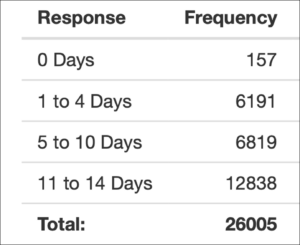
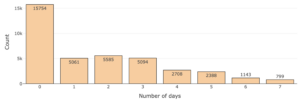
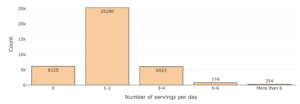
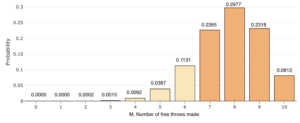
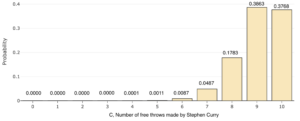
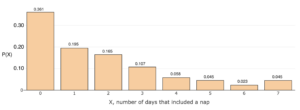
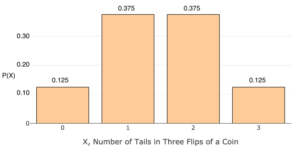
A table with one column labeled Response and another labeled Frequency. The first row says "0 Days" under response and 157 under Frequency. The next row reads "1 to 4 Days" under Response and 6191 under Frequency. Under Response, it reads "5 to 10 Days" and under Frequency, it reads 6819. It reads "11 to 14 Days" under Response and 12838 under Frequency. Lastly, it reads "Total" and then under Frequency, it says "26005."A bar graph with a horizontal axis labeled "Number of days" and a vertical axis labeled "Count" and numbered in increments of 5 thousand. For 0, the count is 15754. For 1, the count is 5061. For 2, the count is 5585. For 3, the count is 5094. For 4, the count is 2708. For 5, the count is 2388. For 6, the count is 1143. For 7, the count is 799.A bar chart labeled "Number of servings per day" on the horizontal axis and "Count" on the vertical axis, and numbered in increments of five thousand. For 0, the count is 6125. For 1-2, the count is 25290. For 3-4, the count is 6023. For 5-6, the count is 774. For more than 6, the count is 254.A bar chart with "M, Number of free throws made" on the horizontal axis and "Probability" on the vertical axis. For 0 and 1, the probability is 0. For 2, the probability is 0.0002. For 3, the probability is 0.0015. For 4, the probability is 0.0092. For 5, the probability is 0.0387. For 6, the probability is 0.1131. For 7, the probability is 0.2265. For 8, the probability is 0.2977. For 9, the probability is 0.2318. For 10, the probability is 0.0812.A bar chart showing "C, Number of free throws made by Stephen Curry" on the x-axis and "Probability" on the y-axis. For 0 through 3, the probability is 0. For 4, the probability is 0.0001. For 5, the probability is 0.0011. For 6, the probability is 0.0087. For 7, the probability is 0.0487. For 8, the probability is 0.1783. For 9, the probability is 0.3863. For 10, the probability is 0.3768.A student napping on a desk in a classroom.A bar chart labeled "X, number of days that included a nap" on the horizontal axis" and "P(X)" on the vertical axis. For 0, P(X) is 0.361. For 1, P(X) is 0.195. For 2, P(X) is 0.165. For 3, P(X) is 0.107. For 4, P(X) is 0.058. For 5, P(X) is 0.045. For 6, P(X) is 0.023. For 7, P(X) is 0.045.A bar chart labeled "X, Number of Tails in Three Flips of a Coin" on the horizontal axis and "P(X)" on the y-axis. For 0, P(X) is 0.125. For 1, P(X) is 0.375. For 2, P(X) is 0.375. For 3, P(X) is 0.125.

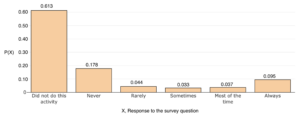
A bar chart labeled "X, Response to the survey question" on the horizontal axis and "P(X)" on the vertical axis. For "Did not do this activity," P(X) is 0.613. For "Never," P(X) is 0.178. For "Rarely," P(X) is 0.044. For "Sometimes," P(X) is 0,033. For "Most of the time," P(X) is 0.037. For "Always," P(X) is 0.095.

Response Frequency Proportion / Relative Frequency
0 Days 157
1 to 4 Days 6,191
5 to 10 Days 6,819
11 to 14 Days 12,838
Total: 26,005 1
Servings per day Frequency Proportion / Relative Frequency
0
1 to 2
3 to 4
5 to 6
More than 6
Total:    
, Number of days
0 0.336
1 0.231
2 0.143
3 0.085
4 0.051
5 0.053
6 0.028
7 0.074
, Number of free throws made
0 0.0000
1 0.0000
2 0.0002
3 0.0015
4 0.0092
5 0.0387
6 0.1131
7 0.2265
8 0.2977
9 0.2318
10 0.0812
, Number of days that included a nap Frequency
0
1
2
3
4
5
6
7
TOTAL:
, Number of days that included a nap ,

The probability of randomly selecting an individual who stated  days with a nap

0
1
2
3
4
5
6
7
SUM:
Experimental Outcome , Number of Tails in 3 Flips of a Coin
HHH 0
HHT
HTH
THH
TTH
THT
HTT
TTT 3
, Number of Tails in 3 Flips of a Coin Frequency Relative Frequency
0
1
2
3 1 0.125
Total: 8 1
, Number of days
0 0.336
1 0.231
2 0.143
3 0.085
4 0.520
5 0.053
6 0.028
7 0.074
, Number of days
0 0.4974
1 0.1811
2 0.1391
3 0.0729
4 0.0377
5 0.0325
6 0.012
7 0.0271
Skill or Concept: I can . . . Questions to check your understanding Rating
from 1 to 5
Make connections between frequency, relative frequency, and probability. 1
Interpret discrete probability distributions to calculate probabilities, including those involving the phrases OR, at least, at most, less than, and greater than. 2
Identify whether a table or graph represents a probability distribution for a discrete random variable. 3

Glossary

discrete random variable
a variable that takes a fixed set of possible numerical values and it is not possible to get any value in between.