Question 1
Research studies of college students suggest that sleep deprivation and daytime sleepiness can have negative consequences, including lower grade point averages, increased risk of academic failure, and impaired mood.[1]To counter sleep deprivation and daytime sleepiness, individuals are often encouraged to nap during the daytime.[2] In fact, some have even argued for colleges to consider building napping stations in their libraries to provide students convenient locations for quick naps.[3]
Credit: iStock/skynesher
- How many days in the last week have you had a nap? How likely do you think it is that a randomly selected classmate has had a nap on a majority of the days in the last week (i.e., in 4 or more days)?
- How do you think the class’s napping habits relate to all college students across the United States?
Question 2
In the preview assignment, you were asked to respond to the following question: “On how many of the last 7 days did you take a nap?”
We will use the possible values to this question as the possible values of our discrete random variable. That is, let’s use “[latex]X[/latex]” to represent the number of days that included a nap.
Using the data provided by your instructor, complete the “Frequency” column in the table below.
| [latex]X[/latex], Number of days that
included a nap |
Frequency |
| 0 | |
| 1 | |
| 2 | |
| 3 | |
| 4 | |
| 5 | |
| 6 | |
| 7 | |
| TOTAL: |
Question 3
Use your frequency table to address the following questions.
- Calculate the probability associated with each value of the random variable, [latex]X[/latex]. That is, calculate the probability of randomly selecting a classmate who had 0 days with a nap. Then repeat this for the other possible values of the random variable. Complete the column “[latex]P(X)[/latex]” in the following table.
[latex]X[/latex], Number of days that included a nap
[latex]P(X)[/latex], The probability of
randomly selecting an individual who stated � days with a nap
0 1 2 3 4 5 6 7 SUM: - Explain how your table illustrates all of the essential properties necessary for a discrete probability distribution.
Question 4
Use the probability distribution you created to address the following questions.
- Suppose you randomly selected an individual from the class. What is the probability of selecting someone who has had a nap on only 1 day in the past week, [latex]P(X = 1)[/latex]?
- Calculate P(3 days or less), or in other words, [latex]P(X≤ 3)[/latex]. Interpret your result.
- Suppose you randomly selected an individual from the class. What is the probability that you select someone who has had a nap on a majority of the days in the past week (i.e., at least 4 days)?
Question 5
A large, national survey[4] conducted by the American College Health Association asked college students the same question that you answered prior to class: “On how many of the last 7 days did you take a nap?” The graph below displays the probability distribution of the random variable [latex]X[/latex], number of days that included a nap.
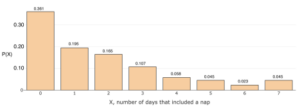
- Compare and contrast this probability distribution with the one associated with the class responses. How are they similar? How are they different?
- What is the probability of selecting a surveyed college student who has had a nap on at most 2 days in the last week?
Put another way, calculate [latex]P(X ≤ 2)[/latex]. - Calculate P(At least 4 days), i.e., [latex]P(X ≥ 4)[/latex]. Interpret your result.
Question 6
Compare your calculations from Question 4, Part C and Question 5, Part C. When compared to those in the national study, is your statistics class more or less likely to find an individual who has had a nap on at least 4 days in the last week?
- Hershner, S. D., & Chervin, R. D. (2014). Causes and consequences of sleepiness among college students. Nature and Science of Sleep, 6, 73–84. https://doi.org/10.2147/NSS.S62907 ↵
- Duggan, K. A., McDevitt, E. A., Whitehurst, L. N., & Mednick, S. C. (2018). To nap, perchance to DREAM: A factor analysis of college students' self-reported reasons for napping. Behavioral Sleep Medicine, 16(2), 135–153. https://doi.org/10.1080/15402002.2016.1178115 ↵
- Wise, M. J. (2018). Naps and sleep deprivation: Why academic libraries should consider adding nap stations to their services for students. New Review of Academic Librarianship, 24(2), 192–210. https://doi.org/10.1080/13614533.2018.1431948 ↵
- American College Health Association-National College Health Assessment. (2020). Undergraduate student reference group data report, Fall 2019. https://www.acha.org/NCHA/ACHA NCHA_Data/Publications_and_Reports/NCHA/Data/Reports_ACHA-NCHAIII.aspx ↵