What you’ll need to know:
In this support activity you’ll become familiar with the following:
- Write a proportion in fraction form from a table.
- Use proportions to answer questions.
You will also have an opportunity to refresh the following skills:
- Simplify fractions by removing common factors.
Throughout this class, you will need to compute fractions, proportions, and percentages and convert from one numeric representation to another. In this support activity, you’ll get practice writing proportions from a table of data as fractions, then use those proportions to answer questions about the data. . You will also have a chance to refresh the skill of simplifying fractions.
Proportions
Proportions represent some part of a set of data out of the total. They help us to compare variations that appear in the data. Since fractions can be used to model part-to-whole relationships, we can use fractions to write proportions mathematically. This representation will help us make comparisons between the different variations appearing in the data in order to answer questions about it.
See the example below for a demonstration of how to write a proportion as a fraction, then try it out yourself using data about the eye colors in a class of students in the activity that follows.
Example
Fractions model part-to-whole relationships.
In other words, we can write a fraction that represents some part out of some whole as [latex]\frac{\text{part}}{\text{whole}}[/latex].
For example, suppose an arrangement of flowers contains 4 yellow daisies, 2 black irises, and 3 red daisies, and 3 white chrysanthemums . Here’s a table containing that information.
| Flower color | Number appearing in the arrangement |
| Yellow | 4 |
| Black | 2 |
| Red | 3 |
| White | 3 |
There are [latex]12[/latex] flowers in the arrangement, which we know by adding up all the numbers in the table.
[latex]4+2+3+3=12[/latex]
If we’d like to know what proportion of the flowers are yellow, we can write a fraction to represent the proportion. There are [latex]4[/latex] yellow flowers out of the total of [latex]12[/latex].
[latex]\dfrac{\text{part}}{\text{whole}}=\dfrac{\text{number that are yellow}}{\text{total number of flowers}}=\dfrac{4}{12}[/latex]
Simplifying fractions
You may recall how to reduce fractions to simplest terms. In this case, since both the numerator and denominator have a common factor of [latex]4[/latex] we can rewrite the fraction.
[latex]\dfrac{4}{12}=\dfrac{1\cdot4}{3\cdot4}=\dfrac{1\cdot\cancel{4}}{3\cdot\cancel{4}}=\dfrac{1}{3}[/latex]
If you don’t remember how to simplify fractions, see the section on this page below, Simplifying Fractions, for a demonstration.
Proportions as representations
It is important to note that both [latex]\frac{4}{12}[/latex] and [latex]\frac{1}{3}[/latex] are useful for representing the proportion of flowers in the arrangement that are yellow.
- [latex]\frac{4}{12}[/latex] tells us that there are exactly 4 yellow flowers out of a total of 12 in the arrangement.
- [latex]\frac{1}{3}[/latex] tells us that a third of the flowers in the arrangement are yellow.
Practice writing a proportion by answering the questions below.
- How many of the flowers are red?
- Write a fraction using the proportion model [latex]\dfrac{\text{part}}{\text{whole}}[/latex] to represent the number of red flowers out of the total number in the arrangement.
- Simplify the fraction if possible.
Let’s explore this idea further using a list of eye colors for students in a class.
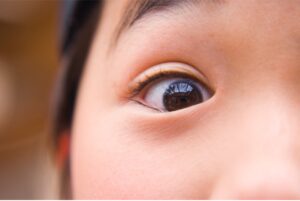
Suppose there are 24 students in a class, and they are asked to record their eye colors. The results are shown in the following table:
| Eye Color | Number of Students |
| Brown | 14 |
| Green | 3 |
| Blue | 6 |
| Hazel | 1 |
Since 3 students have green eyes and there are 24 students in the class, we say “3 out of 24 students have green eyes.” In mathematics, this is represented by the fraction [latex]\frac{3}{24}[/latex]. The numerator, 3, represents the number of students who have green eyes (the part), and the denominator, 24, represents the total number of students in the class (the whole). Answer the following questions using the eye color data in the table.
question 1
Are the eye colors of all 24 students shown in the table above? How can you tell?
Question 2
Continue using the eye color data in the table above to answer the following questions.
Part A: What proportion, or fraction, of the students in the class has brown eyes?
Part B: What proportion, or fraction, of the students in the class has blue eyes?
Part C: Do more than half of the students in the class have brown eyes? Explain.
Part D: If you randomly chose one student from the class, what eye color do you think that student would have? Explain.
Part E: Suppose the students decide to count the eye colors of all their teachers, and they find out 7 of their 12 teachers have brown eyes. Are brown eyes more common among the teachers or among the students?
Simplifying Fractions
Fractions that are written differently, like [latex]\frac{14}{24}[/latex] and [latex]\frac{7}{12}[/latex] may have the same numerical value. There are a couple of ways to see this—by removing common factors or by converting to decimals. Examples of both are shown below.
Removing common factors:
[latex]\frac{14}{24}= \frac{2 \cdot7}{2 \cdot 12}= \frac{7}{12}[/latex]
When we remove all the common factors from the numerator and denominator, we say we have reduced or simplified the fraction.
Converting to decimals:
[latex]\frac{14}{24}=0.5833[/latex]
[latex]\frac{7}{12}=0.5833[/latex]
Question 3
Practice reducing, or simplifying, fractions:
Part A: What proportion of the students has blue eyes? Give your answer as a simplified fraction and check your work by converting to decimals.
Part B: What proportion of the students has green eyes? Give your answer as a simplified fraction and check your work by converting to decimals.
Did you feel comfortable working with the fractions in this support activity? If you feel you need more practice, you can visit the student resources Equivalent Fractions and Fractions, Decimals, Percentages for additional support. It’s time to move on to the What to Know assignment for this section.