what you’ll need to know
In this support activity you’ll become familiar with the following:
- Calculate the slope of a line using [latex]\dfrac{\text{rise}}{\text{run}}.
- Graph a line with a given positive or negative slope.
- Sketch the graph of a line given its y-intercept and slope.
- Identify the y-intercept and slope given the equation of a line.
Previously in the course, you learned to calculate and write an equation for the line of best fit to perform a linear regression analysis for bivariate data. In the next preview assignment and in the next class, you will need to understand slope and read linear equations. You'll prepare for that in this support activity by taking a deeper look into the meaning of the slope, or constant rate of change, in a linear equation.
Triangles
We'll use the triangles in the questions below to build up the idea of slope. Recall that a right triangle is a triangle that contains one right angle (90 degrees).
Rise, Run, and Slope
In this corequisite support activity, we will think of the horizontal side of each right triangle as the base and refer to it as the “run.” In addition, we will refer to the vertical side as the “rise” and the slanted side as the “slant,” as shown below: 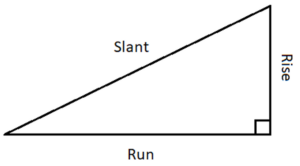
question 1
Consider the right triangles labeled [latex]T_1[/latex], [latex]T_2[/latex], and [latex]T_3[/latex] shown here:
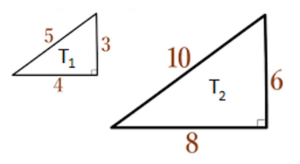
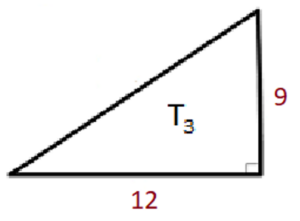
Part A: What is the length of the slant in Triangle [latex]T_1[/latex]?
Part B: What is the length of the rise in Triangle [latex]T_2[/latex]?
Part C: What is the length of the run in Triangle [latex]T_3[/latex]?
Part D: Compare the run of Triangle [latex]T_1[/latex] with the run of Triangle [latex]T_3[/latex]. By what factor must the run of Triangle [latex]T_1[/latex] be multiplied to equal the run of Triangle [latex]T_3[/latex]?
Part E: Compare the rise of Triangle [latex]T_1[/latex]with the rise of Triangle [latex]T_3[/latex]. By what factor must the rise of Triangle [latex]T_1[/latex] be multiplied to equal the rise of Triangle [latex]T_3[/latex]?
Part F: Compute the ratio “rise over run” for each triangle. Hint: You can think of “rise over run” as [latex]\frac{rise}{run}[/latex].
[latex]T_1[/latex]:_____ [latex]T_2[/latex]:____ [latex]T_3[/latex]:_____
Part G: Consider the three ratios computed in Part F. Which ratio is the largest, which is the smallest, and which ratios are equal? It may help to write each of the ratios either as a simplified fraction or in decimal form.
Part H: What is your best guess for the length of the slant of Triangle [latex]T_3[/latex]? Explain.
In Question 1, you saw that the “slant” of a triangle can be expressed using a ratio of it’s “rise” over it’s “run.” If we focus just on the slanted side, and extend it out in either direction to create a line, we call the ratio of the rise over the run for the line “slope.”
Graphing From a Given Slope
You have seen that the slope of a line is computed using the ratio: [latex]\frac{rise}{run}[/latex].
question 2
Consider a line with a slope of [latex]\frac{2}{3}[/latex]. By viewing this fraction in the form [latex]\frac{rise}{run}[/latex], we can identify that the run is 3 and the rise is 2.
Part A: On the following xy-plane, plot any starting point. Then create a right triangle with a run of 3 and rise of 2. Make sure that you move to the right for the run and move up for the rise. The slant of this right triangle has a slope of [latex]\frac{2}{3}[/latex]. Extend this line segment in both directions to create a line with a slope of [latex]\frac{2}{3}[/latex].

Part B: Plot a different starting point on the same [latex]xy[/latex]-plane and use the method introduced in Part A to create a different line with a slope of [latex]\frac{2}{3}[/latex].
Part C: Compare and contrast the two lines from Parts A and B. What is similar and what is different?
In the previous question, both the run and the rise were positive; but sometimes, slopes may have negative values for the run or the rise. On an [latex]xy[/latex]-plane, we define the positive direction on the horizontal axis to be towards the right and the positive direction on the vertical axis to be towards the top. For this reason, a positive run moves to the right and a negative run moves to the left. Similarly, a positive rise moves up and a negative rise moves down.
Consider a line with a slope of [latex]-2[/latex]. To interpret this slope using [latex]\frac{rise}{run}[/latex], it might be helpful to rewrite [latex]-2[/latex] as a fraction like this: [latex]-2 = \frac{-2}{1}[/latex]. In this fraction form, we can determine that the run is [latex]1[/latex] and the rise is [latex]-2[/latex].
question 3
On the following [latex]xy[/latex]-plane, plot any starting point and then create a right triangle with a run of [latex]1[/latex] and a rise of [latex]-2[/latex]. Make sure to move right for the run and move down for the rise. The slant of this right triangle has a slope of [latex]-2[/latex]. Extend this line segment in both directions to create a line with a slope of [latex]-2[/latex].
Graphing From a Given Y-Intercept and Slope
Now that you have a better understanding of how the slope of a line is calculated, and how you can use the slope to graph a line in an [latex]xy[/latex]-plane from any starting point, let’s use the idea of a linear equation to graph a line from a specific starting point.
Recall that a linear equation gives two pieces of information for graphing a line in an [latex]xy[/latex]-plane: the slope and the y-intercept. Think of the y-intercept as the starting point. It’s the location on the y-axis where the line intersects. Use this idea to answer Question 4.
question 4
Consider a line that has a y-intercept of [latex]4[/latex] and a slope of [latex]-0.2[/latex].
Part A: Write the slope as a fraction and then find the run and the rise.
Part B: Plot the y-intercept as your starting point on the following [latex]xy[/latex]-plane. Then use the run and the rise from Part A to sketch this line.
Linear Equations
Recall that a linear equation can be written in the form: [latex]y=mx+b[/latex], where b is the y-intercept and m is the slope.
Question 5
Determine the y-intercept and the slope of the line [latex]y=7x-3[/latex].
question 6
Determine the y-intercept and the slope of the line[latex]y=4+ \frac{2}{3}x[/latex]
Now that you’ve had a closer look at what the slope of a linear equation represents in the relationship between the input and output variables it’s time to move on to the course material and activity.