objectives for this activity
During this activity, you will:
- Identify key components of experimental design, including:
- treatment,
- factor of interest (also known as the explanatory variable or independent variable),
- response variable (also known as the dependent variable),
- nuisance factors,
- random assignment, and
- replication.
- Design a hypothetical experiment to answer a research question.
You learned in the What to Know assignment about the key components of experimental design. In this activity, you’ll practice identifying them as you design a hypothetical experiment to answer a research question. You’ll see that experimental design is a specific method of scientific inquiry and that experiments are useful in determining cause-and-effect relationships between variables. You’ll also see that the three key mechanisms of experimental design are randomization, replication, and comparison.
Coral Bleaching
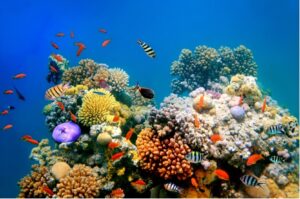
In 2005, the United States lost half of its coral reefs in the Caribbean in one massive bleaching event.[1] When scientists first saw massive coral bleaching events around the world, they thought warming ocean temperatures might be causing the bleaching, but they needed to do more research to find the true cause. Because the scientists wanted to know about cause and effect, experimental design was the best tool for their research.
For more information about coral, visit these National Ocean Service websites:
- https://oceanservice.noaa.gov/facts/coral.html
- https://oceanservice.noaa.gov/facts/coral_bleach.html
- https://oceanservice.noaa.gov/education/tutorial_corals/welcome.html
Guidance
[Intro: In this activity, you will work in groups to design and experiment. The choice of research question and experimental design are yours, but you must follow the statistical principles and practices that you’ve learned about in sections [2A – 2B] and in the preview assignment for this activity. Question 1 will ask you to consider different factors that could impact coral health as a prompt to writing you research question. Take a minute to brainstorm possible factors in your groups. Questions to consider include, “What do plants need to survive?” “What do animals need to survive?” “What are some characteristics of the ocean that have been changing in recent years?”]
Form groups that you’ll remain in throughout this activity to write a research question and design a hypothetical experiment. As you design your experiment, be mindful of the objective to identify key components of experimental design including: treatment, factor of interest, response factor, nuisance factors, random assignment, and replication.
Question 1
What are some other factors that might impact coral health that the researchers should consider?
Use this Experimental Design Worksheet as desired to answer Questions 2 – 4. [link to the worksheet that appears in the DC instructor page for in-class 2C]
Question 2
Write a research question about coral bleaching that can be answered using experimental design. You may consider the causes of bleaching, ways to prevent bleaching, or ways to reverse bleaching.
Now that you have your research question you can design an experiment to answer it.
Question 3
Design an experiment to answer your research question.
Part A: Identify the factors in your experiment.
Factor of interest:
Response factor:
Part B: Describe the set-up and procedure for your experiment. How will you change your factor of interest to create your experimental group? How will it be different in the control group? What other factors will need to be the same in both the experimental and control groups? How will you measure your response variable at the end of the experiment?
Part C: What measures will you take to ensure your results show the effects of your treatment and not other hidden causes?
Follow your instructor’s guidance to answer Question 4.
question 4
Prepare a summary of your proposed experiment to share with your classmates. Be sure to justify your choices regarding experimental design. Your instructor may request a certain format.
Guidance
[Wrap-Up: ” Experimental design is useful in situations where the factor of interest can be manipulated by the researcher. Not all situations are like that though. Can you think of an example where a researcher might not be able to manipulate the factor of interest?”
Examples:
- Does educational level affect income? (Can’t manipulate/randomly assign an education)
- Do men or women have a higher risk of developing heart disease? (Can’t manipulate/assign sex)
- Does smoking cause lung cancer? (Not ethical to randomly assign people to smoke)
In the next activity, you will learn about observational studies through the context of vaccination.”]
- National Ocean Service, National Oceanic and Atmospheric Administration. (2021, February 26). What is coral bleaching? https://oceanservice.noaa.gov/facts/coral_bleach.html ↵