Writers should keep the elements in a sentence consistent, avoiding any unnecessary changes in tense, voice, mood, person, number, and discourse. Such unnecessary changes, or “shifts,” may make reading difficult and obscure the sentence’s meaning for the reader.
Except for special cases where the intended meaning requires a change in tense, maintain the same tense within a sentence.
Error: shift in verb tense
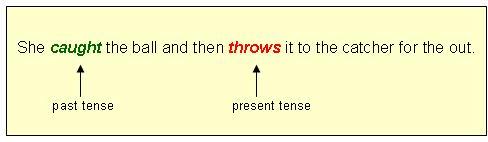
The sentence above begins in the past tense but shifts, without reason, to the present tense.
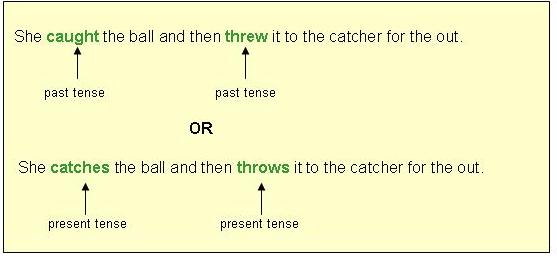
Error repaired:
The voice of a verb may be either active or passive in a sentence. When a sentence contains two or more verbs, both verbs should maintain the same voice.
Error – shift in voice:
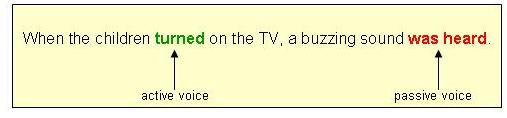
The sentence above begins in active voice but shifts without reason to passive voice.
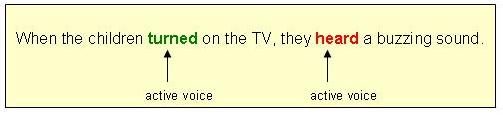
Error repaired:
Example – emphasis on subject requires shift in voice:
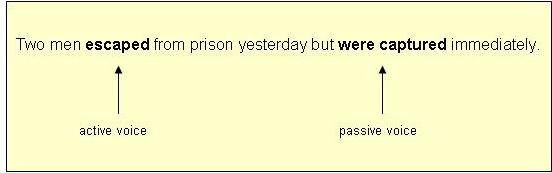
Here, the use of passive allows the sentence to focus on the subject.
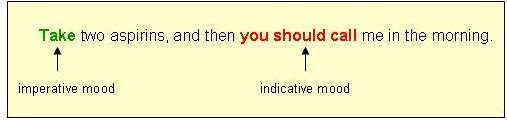
Shifts in mood often occur with directions, where the mood shifts from indicative to imperative or from imperative to indicative.
Error – shift in mood:
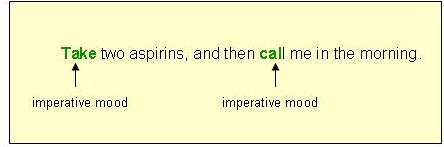
Error repaired:
Person
English has three “persons” or points of view:
- first person – the speaker
I, me, my, mine, we, us, our, ours
- second person – the person spoken to
you, your, yours
- third person – the person or thing spoken about
he, him, his, she, her, hers, it, its, they, them, their
Unless the meaning of a sentence clearly requires a change, keep person consistent within a sentence.
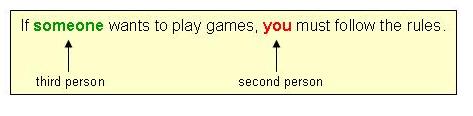
Shifts in person usually occur with changes from the third to the second person point of view.
Error – shift in person:
Error repaired:
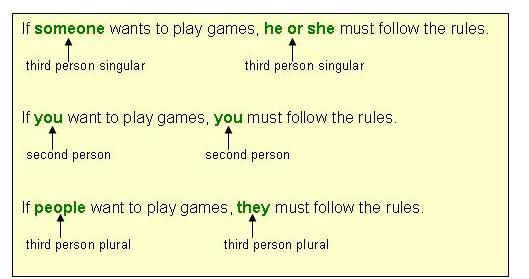
If the meaning of a sentence clearly requires a change, then you may change person as needed.
Example requiring a change in person:
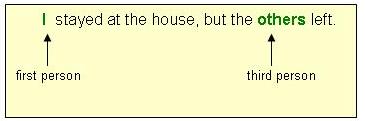
Since both I and the others are doing something in the above sentence, the shift in person is justified.
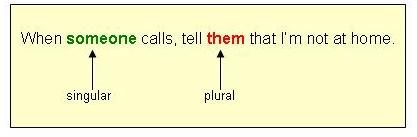
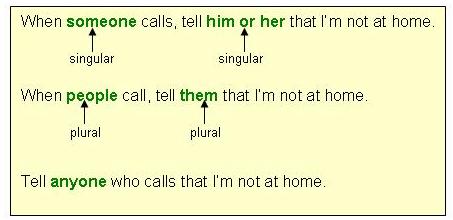
Use singular pronouns to refer to singular antecedents; use plural pronouns to refer to plural antecedents.
Error – shift in number:
Error repaired:
Discourse
There are two ways to recount someone’s words. Each way requires its own format.
A direct quotation gives the exact words of a speaker, surrounding the words with quotation marks.
Example:
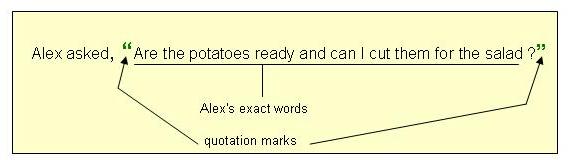
An indirect quotation paraphrases the speaker’s words and does not place them inside quotation marks. Even if the indirect quotation paraphrases a question, the sentence ends with a period.
Example:

Note the difference in the formats above:
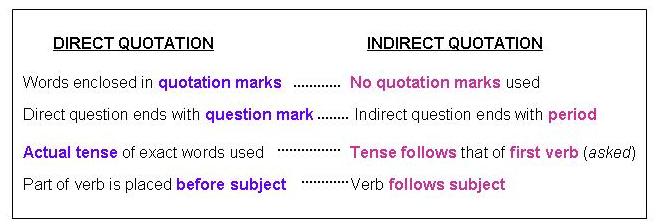
A shift in discourse occurs when, within a sentence, the writer uses the format of one form and shifts some part to the format of the other.
Example – shift in discourse:

Error repaired with indirect discourse:

Error repaired with direct discourse:

Sentence construction
A shift in sentence construction occurs when words or phrases intended for one purpose are used for another, upsetting the natural flow of the sentence. Below are examples of three frequent errors that shift sentence construction. Below each error is an example showing one or more ways to repair the error.
Error –prepositional phrase used as subject:
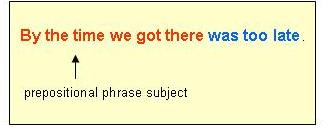
Correct:
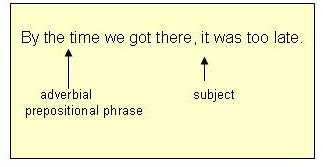
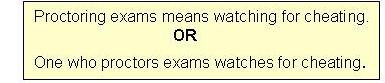
Error – faulty subject:

Correct:
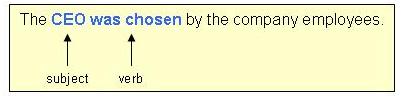
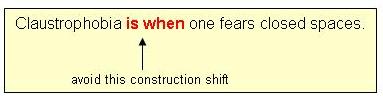
Using is because, is where, or is when in a sentence often creates a construction shift. Avoid this phrasing:
Error – is when
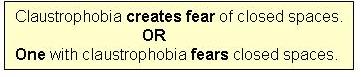
Correct
Candela Citations
- Avoiding Shifts. Authored by: Margaret L. Benner. Provided by: Towson University. Located at: https://webapps.towson.edu/ows/shifts.htm. License: Public Domain: No Known Copyright. License Terms: For educational purposes only