
8E

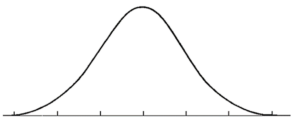
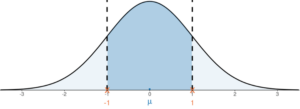
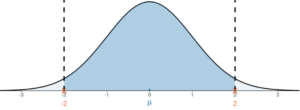
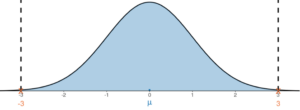
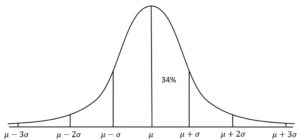
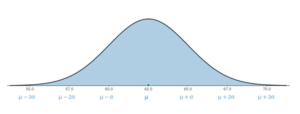
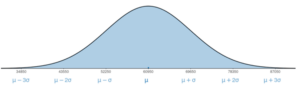
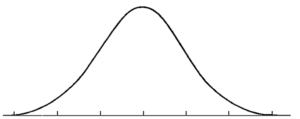
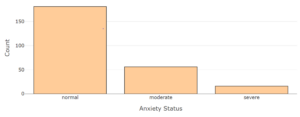
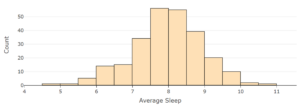
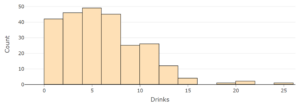
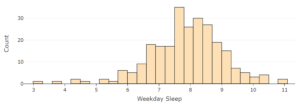
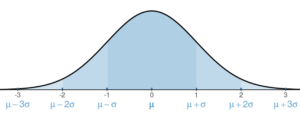
A bell curve with normal distribution. A bell curve centered at 0. There are dotted lines at -1 and 1 and the area between the dotted lines is shaded a darker blue. A bell curve centered at 0. There are dotted lines at -2 and 2 and the area between the dotted lines is shaded a darker blue. A bell curve centered at 0. There are dotted lines at -3 and 3 and the area between the dotted lines is shaded a darker blue. A bell curve centered at mu. There are vertical lines in increments of sigma. The section between mu and mu plus sigma is labeled 34% A curve centered at 62.5. The graph is labeled in increments of 2.5 from 55 to 70.A bell curve centered at 60950. The graph is labeled in increments of 8700 from 34850 to 87050.A collection of things, including some fresh vegetables arranged in a heart dish, a stethoscope, some weights, a cup, and a prescription pad. A bell curve with normal distribution A bar chart labeled "Anxiety Status" on the x-axis and "Count" on the y-axis. For normal, the count is approximately 180. For moderate, the count is approximately 60. For severe, the count is approximately 20.A bar chart labeled "Average Sleep" on the horizontal axis and "Count" on the vertical axis. For 4.5-5.5, the count is approximately 2. For 5.5-6, the count is approximately 6. For 6-6.5, the count is approximately 14. For 6.5-7, the count is approximately 15. For 7-7.5, the count is approximately 34. For 7.5-8, the count is approximately 56. For 8-8.5, the count is 55. For 8.5-9, the count is approximately 40. For 9-9.5, the count is approximately 20. For 9.5-10, the count is 10. For 10-10.5, the count is approximately 3. For 10.5-11, the count is approximately 2.       A bar chart labeled "Drinks" on the horizontal axis and "Count" on the vertical axis. For 0-2, the count is approximately 42. For 2-4, the count is approximately 46. For 4-6, the count is approximately 49. For 6-8, the count is approximately 45, For 8-10, the count is approximately 25. For 10-12, the count is approximately 26. For 12-14, the count is approximately 12. For 14-16, the count is approximately 5, For 18-20, the count is approximately 1. For 20-22, the count is approximately 3. For 24-26, the count is approximately 1.A bar chart labeled "Weekday Sleep" on the horizontal axis and "Count" on the vertical axis. For 3 to 3.3, the count is approximately 1. For 3.6 to 3.9, the count is approximately 1. For 4.2 to 4.5, the count is approximately 2. For 4.5 to 4.8, the count is approximately 1. For 5.1 to 5.4, the count is approximately 2. For 5.4 to 5.7, the count is approximately 1. For 5.7 to 6, the count is 6. For 6 to 6.3, the count is approximately 5. For 6.3 to 6.6, the count is approximately 9. For 6.6 to 6.9, the count is approximately 18. For 6.9 to 7.2, the count is approximately 17, For 7.2 to 7.5, the count is approximately 17. For 7.5 to 7.8, the count is approximately 35. For 7.8 to 8.1, the count is approximately 26. For 8.1 to 8.4, the count is approximately 30. For 8.4 to 8.7, the count is approximately 27. For 8.7 to 9, the count is approximately 19. For 9 to 9.3, the count is approximately 19. For 9.3 to 9.6, the count is approximately 15. For 9.6 to 9.9, the count is approximately 5. For 9.9 to 10.2, the count is approximately 3. For 10.2 to 10.5, the count is approximately 4. For 10.8 to 11.1, the count is approximately 3.A bell curve labeled in increments of sigma, centered on mu. Each increment of sigma also lines up with increments of 1 and mu and 0 are at the same spot on the x-axis.

z-score Value (in inches)
-3
-2
-1
0
1
2
3
Student Scored Better Than % of Peers Approximate
Raw Score
5%
20%
80%
99%
Skill or Concept: I can . . . Questions to check your understanding Rating
from 1 to 5
Understand that every value of a variable that has a normal distribution has a corresponding z-score for the standard normal distribution. 2
Use technology to calculate probabilities for normally distributed variables. 3, 4, 5, Parts A and B
Use the Empirical Rule to identify values that are usual and unusual. 1, 5, Part C
Calculate the percentile for a given probability. 5, Part D