
| Skill or Concept: I can . . . | Questions to check your understanding | Rating from 1 to 5 |
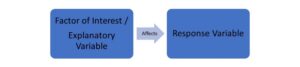
| Identify the factor of interest and response factor in an experiment. | 2, Parts A and B | |
| Identify the nuisance factors in an experiment. | 2, Part C | |
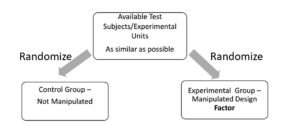
| Identify the experimental and control groups in an experiment. | 3, Parts A and B | |
| Recognize random assignment. | 4 | |
| Describe two methods of replication. | 5 | |
| Answer some basic questions about coral. | 6 |
| Student ID | Heart Rate Before Activity
(in bpm) |
Heart Rate
After Activity (in bpm) |
| 01 | 82 | 74 |
| 02 | 76 | 84 |
| 03 | 64 | 78 |
| 04 | 80 | 92 |
| 05 | 72 | 84 |
| Student ID | Heart Rate Before Activity
(in bpm) |
Heart Rate
After Activity (in bpm) |
Change in Heart Rate
(in bpm) |
| 01 | 82 | 74 | |
| 02 | 76 | 84 | |
| 03 | 64 | 78 | |
| 04 | 80 | 92 | |
| 05 | 72 | 84 |
| Participant ID | Date of Birth | Depression Score |
| 01 | 12/13/1957 | 4 |
| 02 | 04/05/1958 | 1 |
| 03 | 07/08/1934 | 2 |
| 04 | 08/25/1994 | 1 |
| 05 | 03/15/2001 | 3 |

| Average Heart Rate (H) as a Percentage of Maximum Heart Rate | Number of Adults |
| H less than 50% | 3 |
| H between 50% and 70% | 5 |
| H at or above 70% | 13 |
| Experimental Study | Observational Study | |
| 1) A treatment is assigned | ||
| 2) Used to investigate cause and effect | ||
| 3) Random assignment of participants to groups | ||
| 4) Used to investigate an association | ||
| 5) Used to generalize to a population |
| Skill or Concept: I can . . . | Questions to check your understanding | Rating from 1 to 5 |
| Identify an observational study. | 2 | |
| Understand why observational studies are used. | 3 | |
| Identify a confounding variable in an observational study. | 4 | |
| Identify the difference between an experimental study and an observational study. | 5, 6 |
Glossary 2C
- explanatory variable
- the variable that is of interest to the researcher and is controlled by the researcher, also referred to as the independent variable or factor of interest.
- response variable
- the variable that allows the researcher to objectively compare the differences in the levels of the factor of interest, also referred to as the dependent variable.
- treatments
- the different levels of the factor of interest you are changing.
- nuisance factors
- factors that are kept the same across all levels of the factor or are explicitly controlled in the experimental design. These factors are not of interest in the study but may affect a change in the response variable.
Glossary 2D
- experimental study
- a statistical study based on data collected from designed experiments and is useful for determining cause and effect.
- observational study
- a study where a researcher will observe an outcome without changing who is and who is not exposed to some sort of treatment.
- confounding variable
- a variable that was not accounted for in a study and may actually influence other variables in a study